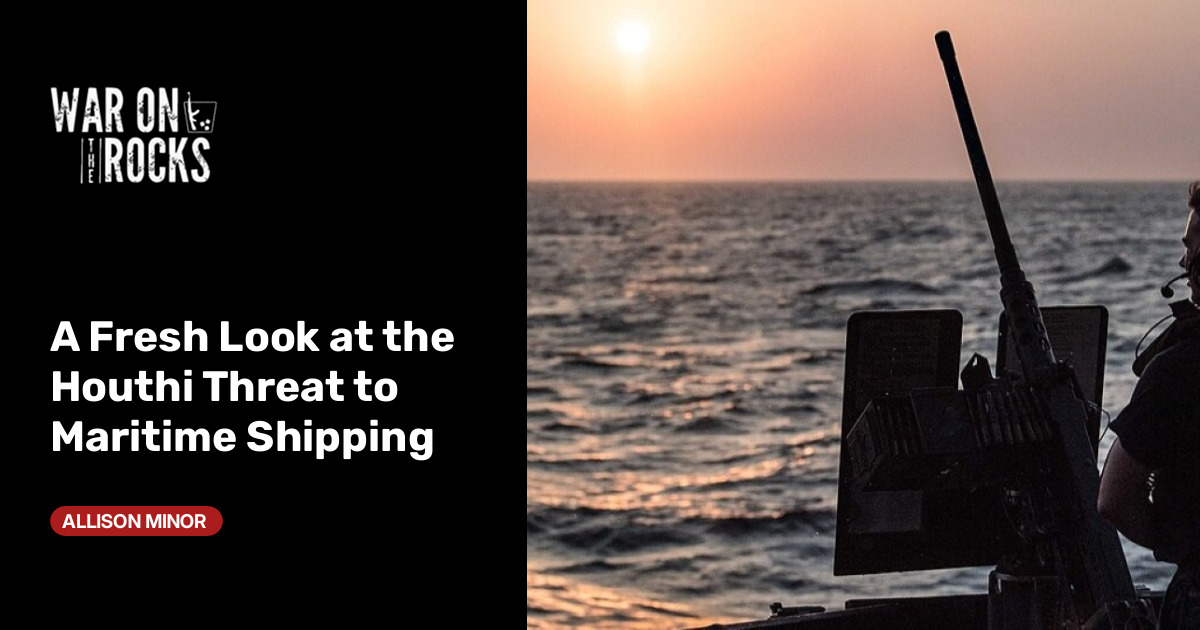
In 2024, Allison Minor wrote, “Solving the Houthi Threat to Freedom of Navigation,” where she argued the international response to Houthi attacks on shipping in the Red Sea has so far been inadequate and proposed a U.N.-led solution. Two years later, with global attention once again focused on maritime shipping activity, we asked Allison to review her arguments. Image: Petty Officer 1st Class Jonathan Word via DVIDSWhen you wrote about the Houthi threat in 2024, the activities in the Red Sea commanded high global attention. Two years on, that attention has largely shifted to the Strait of Horm
The re-visiting of Allison Minor's 2024 analysis in 2026 highlights the persistent and evolving nature of maritime shipping threats, particularly as global attention shifts to new flashpoints like the Strait of Hormuz.
A strategic reader should care because the sustained Houthi threat, despite changing global attention, underscores the fragility of global supply chains and the inadequacy of current international response mechanisms, impacting trade and defence postures.
The shift in focus from the Red Sea to the Strait of Hormuz indicates a widening and persistent challenge to maritime security, requiring adaptive strategies and potentially new alliances to safeguard critical shipping lanes.
- · Defence contractors specializing in naval protection and surveillance
- · Nations with strong navies and agile intervention capabilities
- · Maritime logistics companies adopting diversified routes or enhanced security
- · Global shipping companies reliant on vulnerable choke points
- · Nations lacking naval power to protect their trade routes
- · International organizations unable to coordinate effective responses
Ongoing Houthi activities continue to disrupt maritime trade routes, leading to increased shipping costs and extended transit times.
Persistent threats in key waterways could accelerate investment in alternative shipping technologies or land-based trade corridors.
Escalating maritime insecurity could lead to a re-evaluation of global naval power projections and increased defence budgets for maritime security.
This signal links to a primary source. Continuum Brief monitors and indexes it as part of the live intelligence stream — we do not republish source content.
Read at War on the Rocks