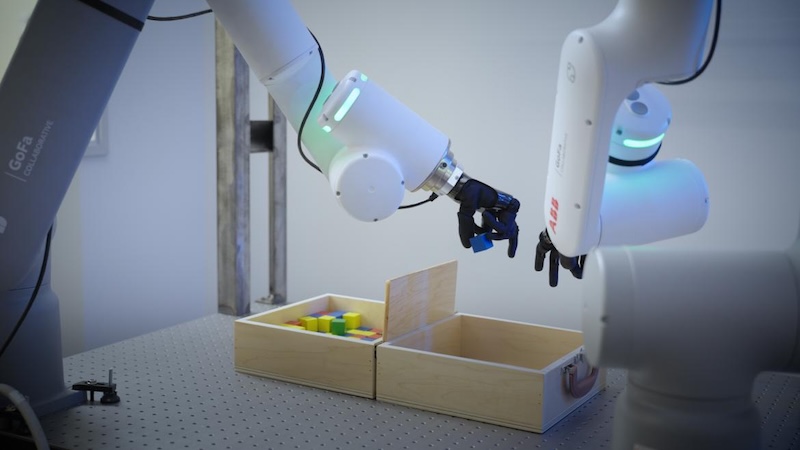
Dexterity remains a major challenge for industry; improved handling can reduce engineering time by up to 30% ABB Robotics is collaborating with California bionics company, Psyonic, to advance robotic gripping and dexterity using a new approach that utilizes real-world manipulation data from human prosthetic use. By combining the Psyonic Ability Hand with an ABB GoFa […]
The accelerating advancements in AI and robotics, coupled with the long-standing challenge of robotic dexterity in industrial settings, make this collaboration timely.
This development represents a significant step towards more capable and autonomous robots, potentially leading to increased automation in tasks previously limited by robotic manipulation.
The approach of using human-generated data from prosthetic use directly addresses a key limitation in robotic dexterity, offering a more effective training methodology than traditional programming.
- · Robotics manufacturers
- · Industrial automation sector
- · Logistics and supply chain
- · Advanced manufacturing
- · Companies reliant on manual dexterous labor
- · Traditional robotics development methodologies
Improved robotic dexterity will enable automation in more complex industrial tasks.
This advancement could accelerate the deployment of general-purpose robots into various sectors beyond manufacturing.
The success of this data-driven approach could fundamentally shift how robotic systems are designed, trained, and deployed, emphasizing 'learning from human data' over 'explicit programming'.
This signal links to a primary source. Continuum Brief monitors and indexes it as part of the live intelligence stream — we do not republish source content.
Read at Robotics & Automation News