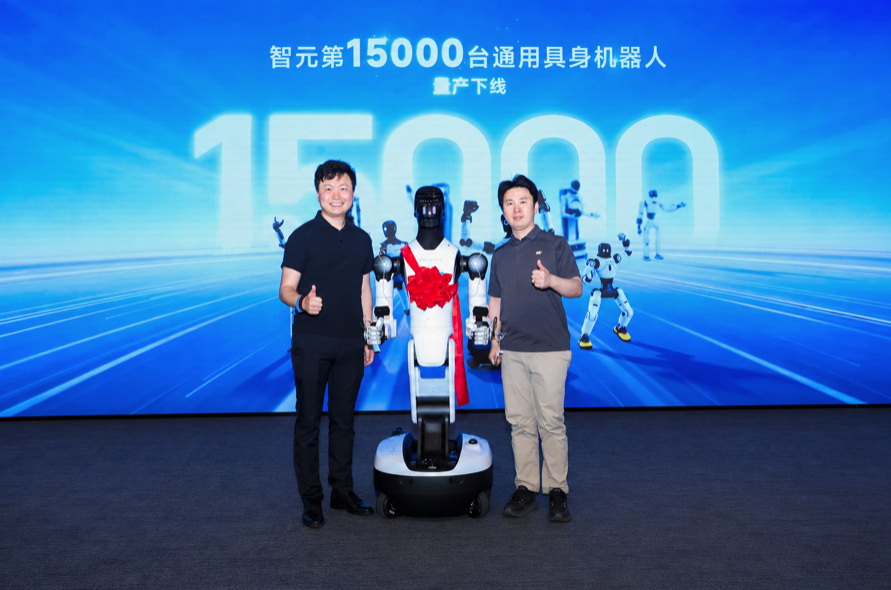
Agibot, a global leader in embodied AI and robotics, has announced that its 15,000th robot has officially rolled off the production line. The milestone unit is the Agibot G2, an industrial-grade embodied task robot designed for industrial and real-world operational scenarios. Following the rollout of its 5,000th and 10,000th robots, this latest milestone marks another […]
Humanoid robotics manufacturing is scaling rapidly, driven by technological advancements in embodied AI and demand for automation in industrial settings.
This milestone indicates increasing production capacity and industrial utilization of humanoid robots, suggesting a faster path to commercial viability and widespread adoption.
The accelerated output and industrial focus from a leading embodied AI company like Agibot shifts the timeline closer for ubiquitous humanoid robot deployment in various sectors.
- · Agibot
- · Automation sector
- · Manufacturing industries
- · Embodied AI developers
- · Tasks requiring repetitive manual labor
- · Traditional industrial automation lacking embodied AI
- · Countries with high labor costs and low automation adoption
The rapid scaling of humanoid robot production will reduce per-unit costs, making them more accessible to a wider range of industries.
Increased deployment of industrial humanoid robots will accelerate improvements in their capabilities and integration into existing operational frameworks, pushing general-purpose humanoid development.
Widespread adoption could lead to significant labor market restructuring and require new models for human-robot collaboration and economic distribution.
This signal links to a primary source. Continuum Brief monitors and indexes it as part of the live intelligence stream — we do not republish source content.
Read at Robotics & Automation News