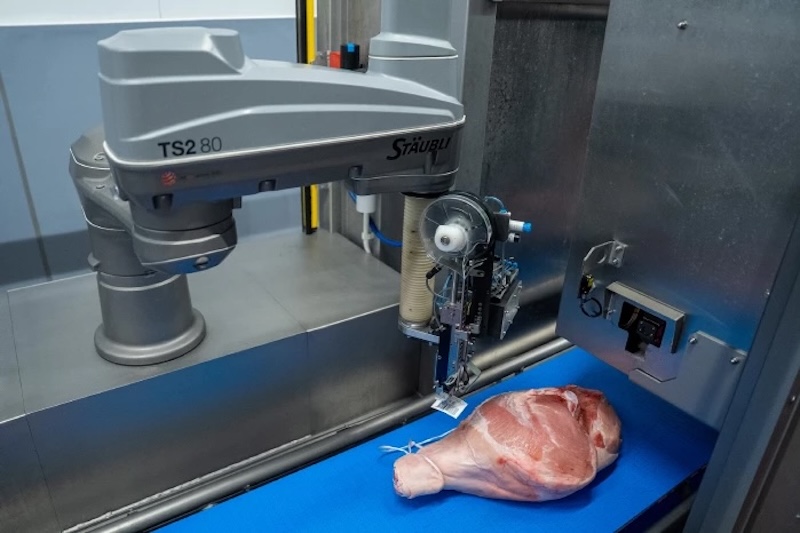
Until recently, labeling Serrano hams, which is a must because it determines their progression through different aging and drying processes, was a laborious task. Since a robot could not detect the bones in the ham, human involvement was indispensable. Now, a Spanish systems integrator has developed an AI-based robotic system capable of performing this task. […]
Advances in AI, particularly in computer vision and robotic manipulation, have reached a point where complex, previously human-exclusive tasks like identifying bone structures in irregular organic objects are now automatable.
This development signifies AI's growing capability to automate intricate manual labor in sectors previously resistant to full automation, potentially impacting labor markets and industrial efficiency.
Previously unautomatable tasks in the food processing industry, due to lack of robot dexterity and perception, can now be tackled by AI-powered robotic systems, leading to increased efficiency and reduced human intervention.
- · Food processing companies
- · Robotics integrators
- · AI developers
- · Industrial automation sector
- · Manual labor in food processing
- · Companies reliant on traditional processing methods
Increased efficiency and consistency in specialized food product labeling and processing.
Broader adoption of AI-powered robotics in other agricultural and food manufacturing sectors requiring nuanced object handling.
Displacement of labor in specific manual processing roles, leading to shifts in workforce skill demands within the food industry.
This signal links to a primary source. Continuum Brief monitors and indexes it as part of the live intelligence stream — we do not republish source content.
Read at Robotics & Automation News