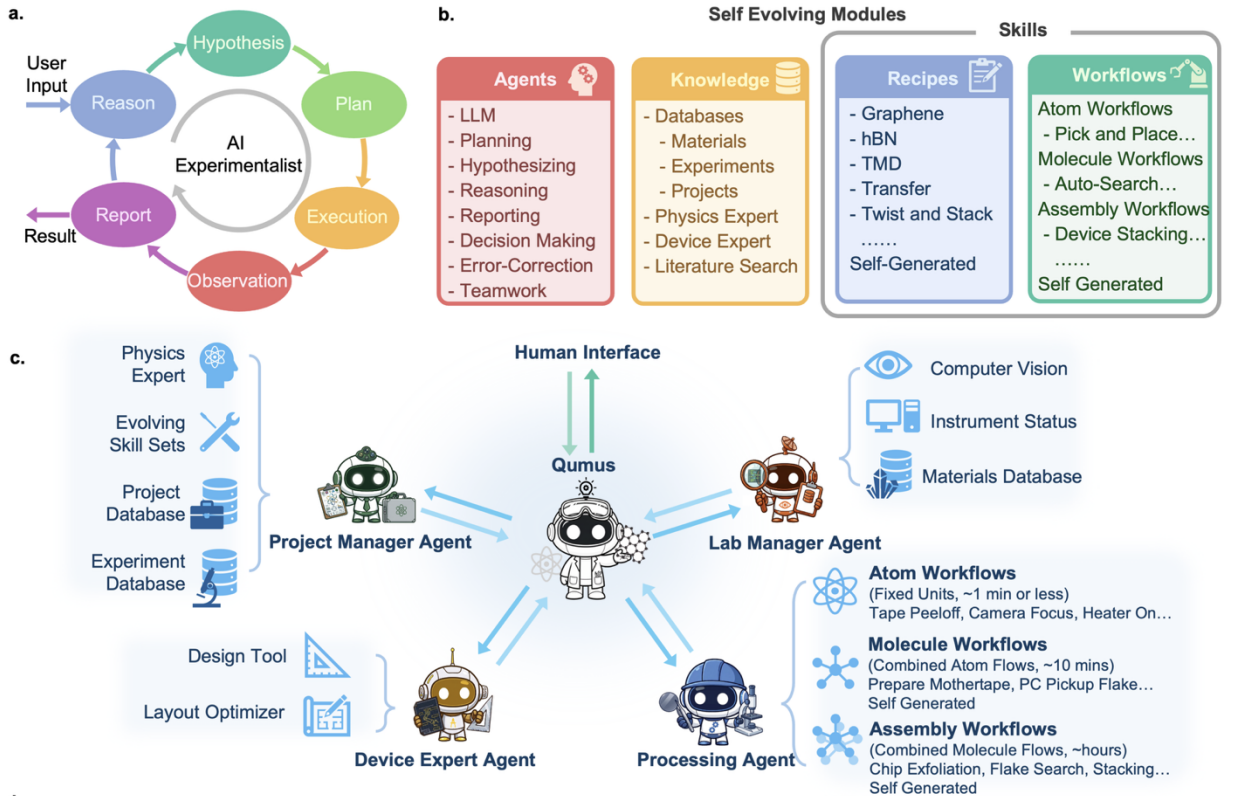
Insider Brief An autonomous quantum materials research system has taken a step toward turning AI from a digital assistant into a physical laboratory scientist by autonomously creating graphene and fabricating atomically thin transistors inside a robotic mini-lab, according to a new study from researchers at Princeton University and collaborators. The system, described in a paper […]
Advances in AI, robotics, and quantum material science are converging, enabling automated scientific discovery in laboratories. This particular breakthrough highlights the growing sophistication of autonomous systems in complex research environments.
This development signifies a substantial acceleration in materials discovery and device fabrication, removing major bottlenecks in research and development cycles critical for future technologies. It demonstrates a foundational shift in how scientific innovation can be pursued.
The traditional, human-centric model of laboratory research is evolving towards autonomous AI and robotic systems, compressing discovery timelines and potentially leading to new materials and devices at an unprecedented pace. This enables new avenues for quantum technology development.
- · Quantum materials researchers
- · Robotics and AI companies
- · Quantum computing industry
- · Advanced manufacturing
- · Traditional manual lab work
- · Sectors reliant on slow material discovery
Autonomous systems rapidly discover and synthesize novel materials and quantum devices, substantially accelerating technological progress.
The cost and time required for materials science R&D dramatically decreases, making advanced materials more accessible and fostering new industries.
This could lead to a 'materials arms race,' where nations and corporations compete for supremacy in AI-driven material discovery to gain strategic advantages.
This signal links to a primary source. Continuum Brief monitors and indexes it as part of the live intelligence stream — we do not republish source content.
Read at The Quantum Insider