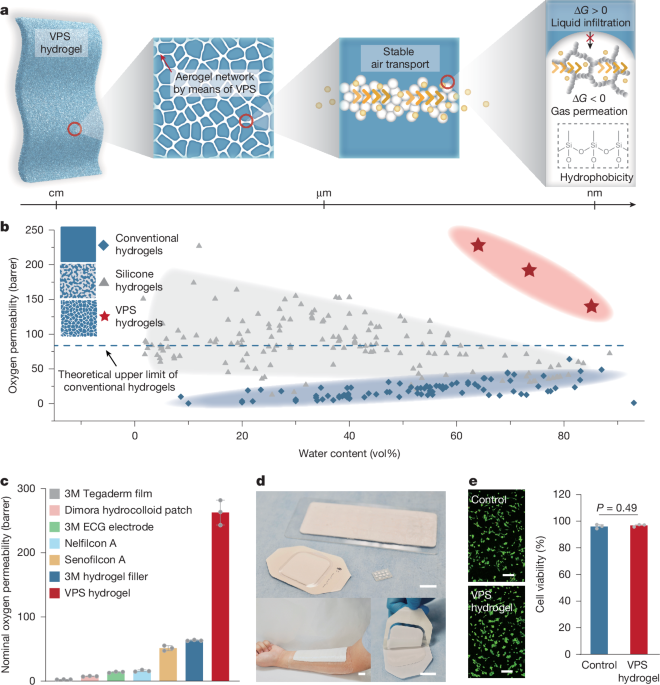
Nature, Published online: 08 July 2026; doi:10.1038/s41586-026-10712-3 Viscoelastic phase separation is used to fabricate non-collapsible, air-rich networks in high-water-content hydrogels containing silica aerogel beads, allowing air to permeate through the material and enabling a tenfold increase in oxygen permeability over pristine hydrogels.
This research provides a novel method for creating highly permeable hydrogels, addressing a long-standing challenge in material science related to oxygen transport in soft materials.
Improved oxygen permeability in hydrogels has broad implications for biomedical applications, particularly in tissue engineering, wound healing, and advanced filtration systems, where oxygen exchange is crucial.
The ability to fabricate non-collapsible, air-rich hydrogels with significantly enhanced oxygen permeability opens new avenues for designing biomaterials and other applications requiring efficient gas exchange.
- · Biomedical material developers
- · Tissue engineering researchers
- · Wound care product manufacturers
- · Filtration technology companies
Significantly more effective hydrogel-based medical devices become possible due to increased oxygen flow.
New surgical techniques leveraging these enhanced hydrogels could emerge, improving patient outcomes and reducing recovery times.
The principle of viscoelastic phase separation could be extended to other material types for novel functional applications beyond hydrogels.
This signal links to a primary source. Continuum Brief monitors and indexes it as part of the live intelligence stream — we do not republish source content.
Read at Nature — Latest Research