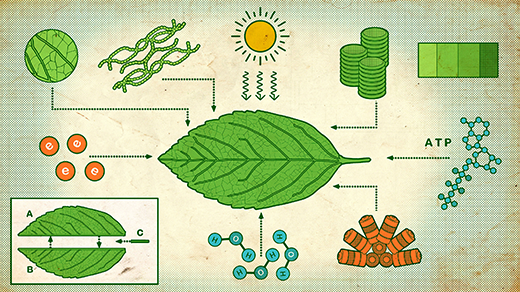
An ancient lineage of cyanobacteria is helping biologists uncover an early evolutionary stage of the mind-boggling process that turns light into life. The post An Early Step on the Long, Strange Road to Photosynthesis first appeared on Quanta Magazine
The continuous advancements in biological research and genetic sequencing capabilities are enabling deeper probes into ancient life forms. New techniques allow for the study of difficult-to-culture cyanobacteria, pushing the boundaries of evolutionary biology.
Understanding the early evolutionary stages of photosynthesis provides fundamental insights into energy conversion, atmospheric oxygenation, and the origins of complex life. This knowledge can inform bioengineering efforts and astrobiology.
This discovery refines our understanding of how photosynthesis evolved, potentially offering new blueprints for more efficient artificial photosynthesis or bio-inspired technologies. It changes the historical timeline and mechanisms previously assumed for this critical biological process.
- · Synthetic biology researchers
- · Bioengineers
- · Astrobiology community
- · Biotechnology sector
- · Researchers operating with outdated photosynthesis evolutionary models
Refined scientific understanding of early Earth's atmosphere and anoxia-tolerant photosynthetic life.
Potential for new industrial applications in bio-manufacturing or sustainable energy following lessons from ancient photosynthetic mechanisms.
Enhanced efforts in directed evolution or genetic engineering to replicate and optimize rediscovered ancient photosynthetic pathways for carbon capture or biofuel production.
This signal links to a primary source. Continuum Brief monitors and indexes it as part of the live intelligence stream — we do not republish source content.
Read at Quanta Magazine