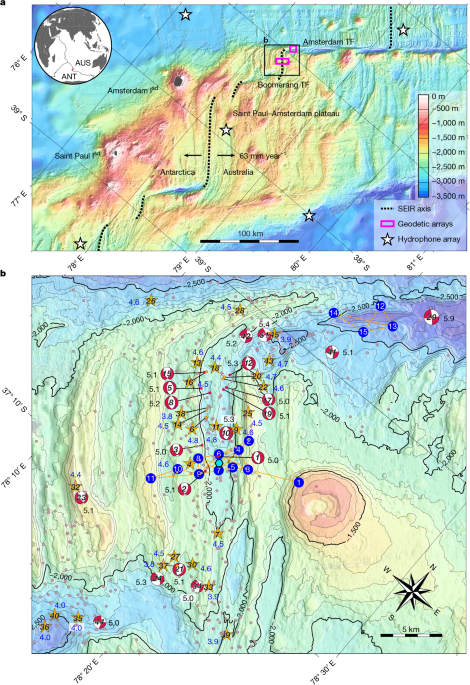
Nature, Published online: 08 July 2026; doi:10.1038/s41586-026-10785-0 By combining hydroacoustic, direct-path ranging and bottom-pressure measurements, in situ observations of a rifting event at a segment of the Southeast Indian Ridge are reported, providing insight into seafloor spreading events on yearly timescales.
This research provides new in situ observations of seafloor spreading, which is a continuous geological process.
While scientifically significant for understanding planetary geology, this specific research is not directly relevant to immediate strategic interests or economic shifts for a sophisticated reader.
This research provides enhanced understanding of fundamental geophysical processes but does not alter any existing strategic or economic landscapes.
Improved understanding of oceanic crust formation.
Refined models for plate tectonics and mantle convection.
Potentially better long-term understanding of resource distribution related to seafloor processes.
This signal links to a primary source. Continuum Brief monitors and indexes it as part of the live intelligence stream — we do not republish source content.
Read at Nature — Latest Research