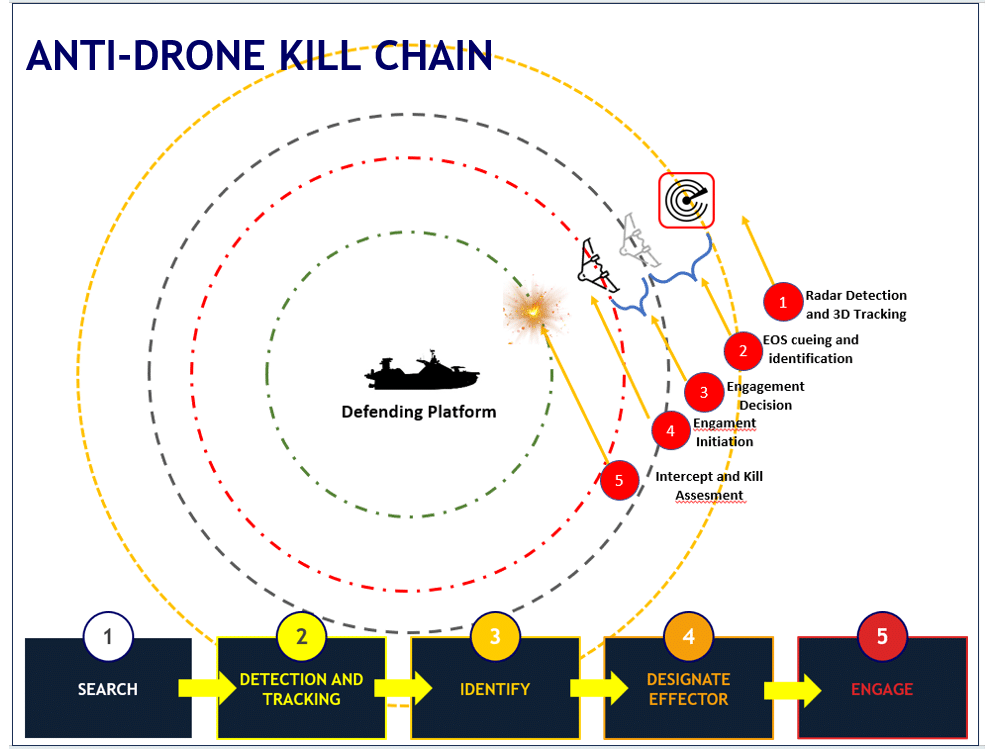
Effective Anti-Drone Warfare demands a complete kill chain – detection, identification, tracking, and hard-kill engagement – with every link matched to the physics and economics of the Tier 2 OWA drone threat. This article examines the technology choices for each link: why only AESA radar meets the detection requirement, what the electro-optic director must deliver, ... The post Anti-Drone Warfare at Sea: Matching Sensors and Effectors to the Threat appeared first on Naval News .
The rapid proliferation of cheap, effective drones by non-state and state actors necessitates advanced counter-drone capabilities at sea, especially given ongoing conflicts demonstrating their impact.
This highlights the urgent strategic shift towards robust anti-drone warfare at sea, which is critical for naval force protection and preserving operational freedom in future conflicts.
The focus moves from general naval defence to specific, integrated counter-drone kill chains involving advanced sensors like AESA radar and precise effectors against small, numerous threats.
- · Defence contractors specializing in AESA radar
- · Makers of electro-optic directors and integrated C-UAS systems
- · Navies adopting advanced counter-drone strategies
- · Companies like ULAQ GLOBAL
- · Naval forces reliant on legacy air defence systems
- · Tactics that don't account for swarming drone attacks
- · Traditional radar manufacturers without AESA capabilities
Increased investment and R&D into integrated maritime counter-drone systems will accelerate.
Naval fleet compositions and procurement priorities will shift to incorporate more dedicated counter-drone platforms and technologies.
The economic barrier to naval aggression might be lowered for non-state actors, potentially increasing regional instability if counter-drone systems are not widely adopted.
This signal links to a primary source. Continuum Brief monitors and indexes it as part of the live intelligence stream — we do not republish source content.
Read at Naval News