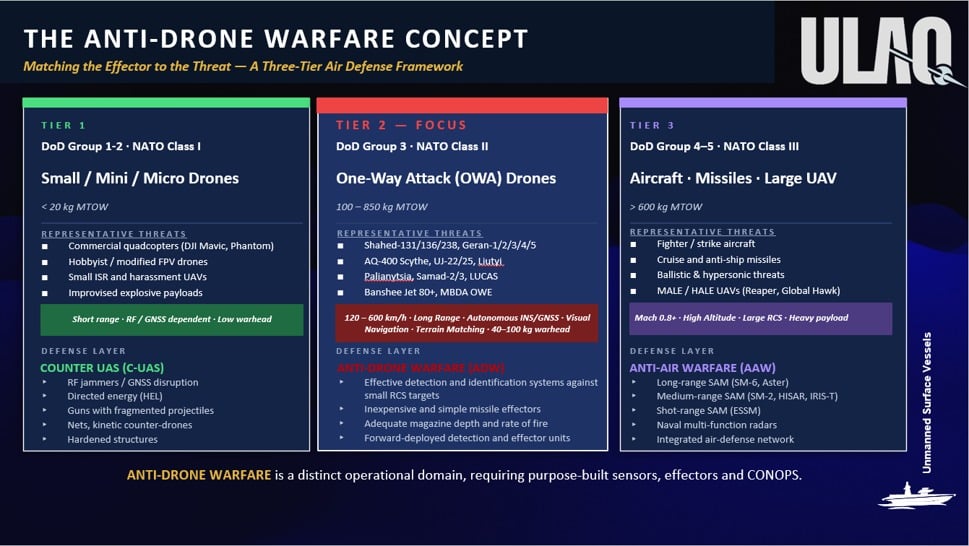
The proliferation of autonomous one-way attack (OWA) drones has exposed a critical gap in defence architecture: Anti-Drone Warfare (ADW) is neither conventional air defence nor C-UAS. It is a distinct operational domain — with unique threat physics, unique engagement economics, and unique platform requirements. For maritime environments, that gap is structural and cannot be closed ... The post Anti-Drone Warfare: The Missing Tier in Maritime Defence Architecture appeared first on Naval News .
The increasing proliferation and effectiveness of autonomous one-way attack drones in recent conflicts are forcing a re-evaluation of maritime defence strategies.
This highlights a critical and under-addressed vulnerability in naval architecture, demanding distinct solutions that transcend traditional air defence or C-UAS approaches.
Defence doctrines will evolve to incorporate a dedicated anti-drone warfare tier, leading to new R&D priorities and procurement in maritime defence.
- · Defence Tech companies (especially C-UAS/ADW)
- · Navies investing early in ADW
- · Specialized sensor and effector developers
- · Navies with outdated defence doctrines
- · Traditional air defence system manufacturers
- · Slow-adapting defence contractors
Increased investment in bespoke maritime anti-drone warfare systems and platforms.
Development of new naval vessel designs incorporating integrated anti-drone capabilities as a primary feature.
Potential for a global arms race in both autonomous attack drones and advanced anti-drone defence systems, particularly in contested maritime regions.
This signal links to a primary source. Continuum Brief monitors and indexes it as part of the live intelligence stream — we do not republish source content.
Read at Naval News