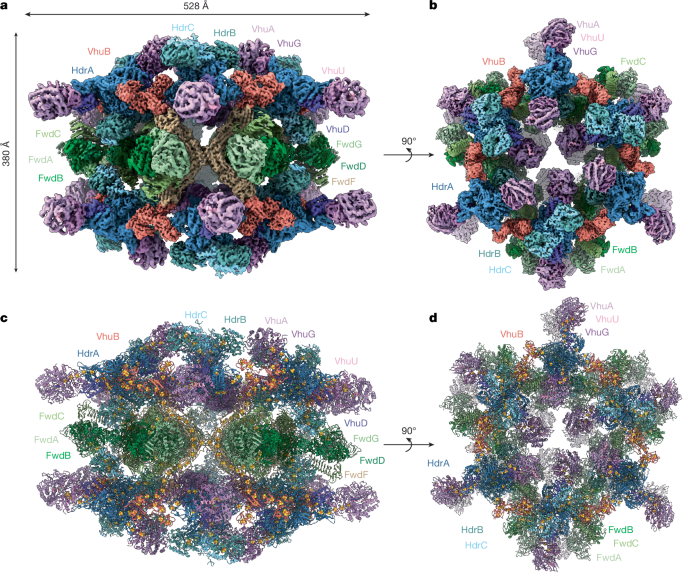
Nature, Published online: 08 July 2026; doi:10.1038/s41586-026-10744-9 The structure of the Hdr–Vhu–Fwd super-assembly reveals a lineage-specific and modular 8 MDa complex with the ability to adapt to diverse anaerobic niches.
The publication is a recent scientific discovery, representing a new understanding of complex biological machinery involved in methanogenesis, specifically in class I methanogens. This is part of ongoing fundamental research in biochemistry and microbiology.
Understanding the architecture of such large and complex super-assemblies can provide insights into fundamental life processes in extreme anaerobic environments, potentially informing biotechnological applications, especially in areas like bioenergy or waste management, and expanding the scope of synthetic biology applications.
This research provides a detailed structural blueprint of a crucial multi-protein complex, revealing its modularity and adaptability, thereby enhancing the foundational knowledge of microbial metabolism in challenging environments. This specific understanding could inform future targeted interventions or engineering of these systems.
- · Biotechnology sector
- · Synthetic biology researchers
- · Bioenergy companies
- · Waste treatment industries
- · Fossil fuel industry (indirect, long-term conceptual competition)
Enhanced understanding of microbial metabolism in anaerobic conditions.
Potential for designing novel biotechnological processes based on methanogen enzymatic pathways for sustainable energy or industrial applications.
Long-term development of highly efficient bio-reactors capable of converting diverse organic waste into methane as a clean energy source.
This signal links to a primary source. Continuum Brief monitors and indexes it as part of the live intelligence stream — we do not republish source content.
Read at Nature — Latest Research