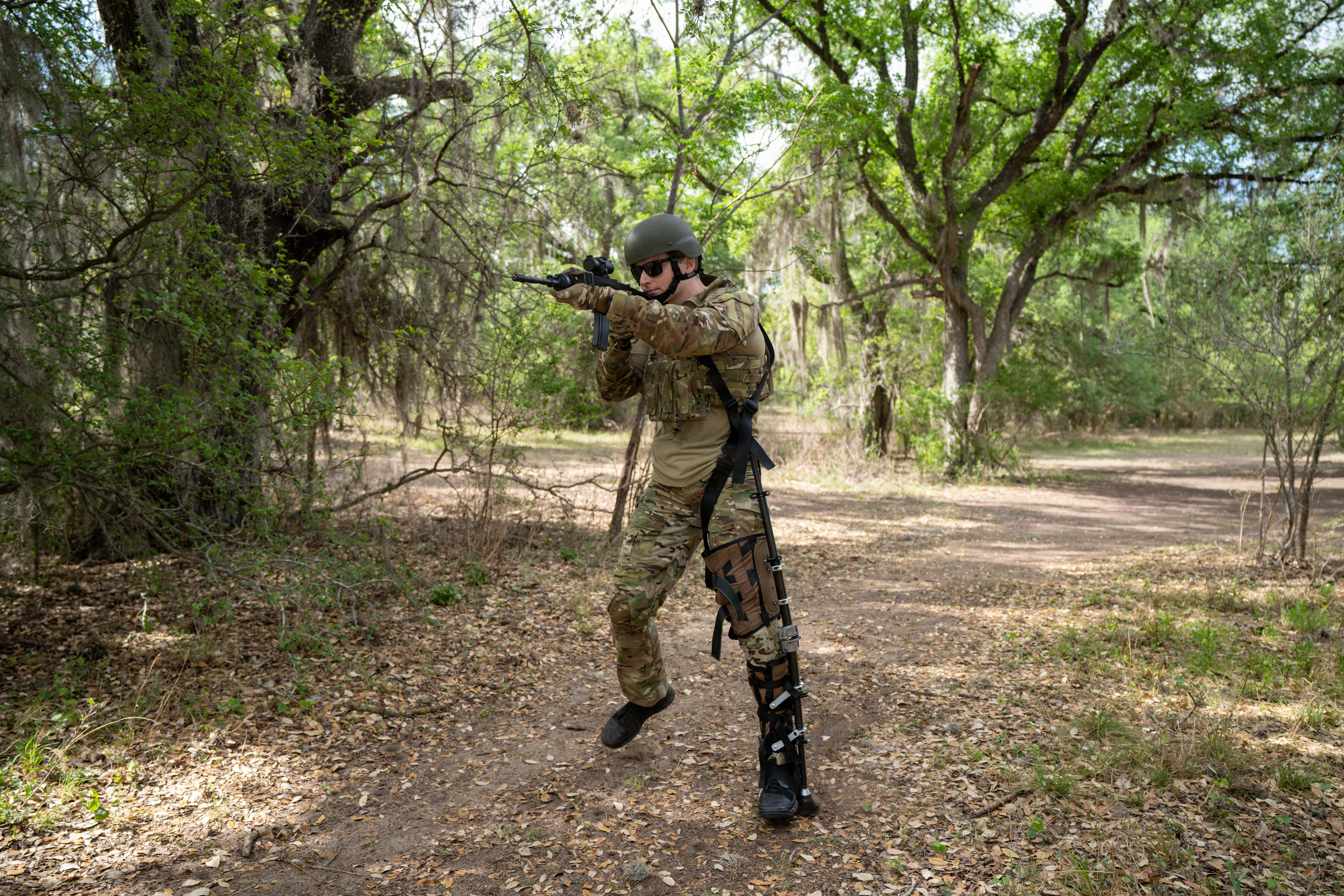
The Army is developing a new exoskeleton that allows injured troops to stand, walk and shoot when evacuation is impossible or delayed.
Advances in robotics, material science, and battery technology are converging, making practical battlefield exoskeletons feasible for immediate deployment scenarios where traditional medical evacuation is hindered by peer-on-peer conflict. The ongoing lessons from recent conflicts highlight the critical need for improving force readiness and reducing casualties in contested environments.
This development represents a tactical evolution in military medicine and soldier endurance, potentially reducing immediate combat fatalities and enhancing operational capabilities under duress. For a strategic reader, it signifies a broader trend of leveraging advanced robotics to maintain combat effectiveness in high-intensity kinetic environments.
Injured soldiers may now be able to self-extract or continue fighting in situations previously deemed incapacitating, altering tactical engagement dynamics and casualty management protocols. This moves beyond traditional medical support to direct combat augmentation for injured personnel.
- · Defence contractors (robotics, materials)
- · Military personnel (enabled to fight/survive better)
- · Field medics and combat lifesavers
- · Robotics and advanced manufacturing sectors
- · Adversaries relying on traditional casualty effects
- · Logistics chains for rapid medical evacuation (to a limited extent)
Injured soldiers can maintain combat function or self-extract, reducing immediate fatalities and improving unit cohesion.
Adversarial forces will need to adapt their tactics to account for enhanced resilience of individual combatants, potentially leading to increased lethality of future engagements.
The technology could eventually trickle down to civilian applications, revolutionizing rehabilitation and assistive technology for those with lower-limb injuries, impacting healthcare costs and accessibility.
This signal links to a primary source. Continuum Brief monitors and indexes it as part of the live intelligence stream — we do not republish source content.
Read at C4ISRNET