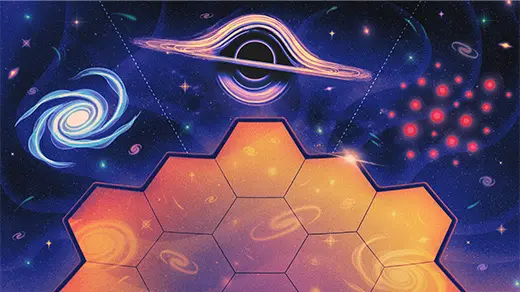
Faced with observations of early black holes and galaxies that weren’t expected to exist, scientists have come up with a wealth of new theories to explain them. Now they just need to figure out which ones are true. The post Astrophysicists Puzzle Over Webb’s New Universe first appeared on Quanta Magazine
The James Webb Space Telescope continues to deliver novel observations, challenging existing astrophysical models and prompting new theoretical development.
This highlights the ongoing iterative process of scientific discovery, where observations drive new theories, but does not immediately alter geopolitical, market, or tech dynamics.
Current astrophysical models are being refined or expanded to accommodate new data, but fundamental scientific understanding is not immediately overturned.
- · Astrophysicists
- · Space science institutions
Existing cosmological theories are being re-evaluated in light of Webb's findings.
New theoretical frameworks could lead to a deeper understanding of the early universe.
Long-term, this could influence the direction of future space missions and astronomical research priorities.
This signal links to a primary source. Continuum Brief monitors and indexes it as part of the live intelligence stream — we do not republish source content.
Read at Quanta Magazine