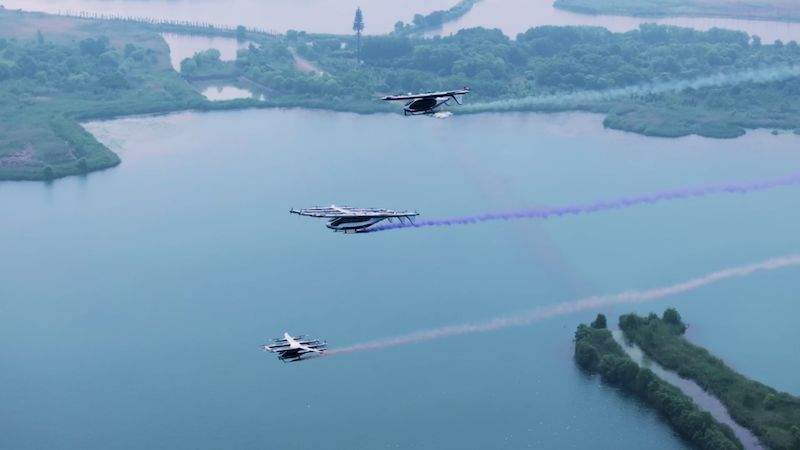
AutoFlight has completed a mixed-fleet formation flight of three aircraft, comprising one V5000 Matrix and two V2000-series eVTOL aircraft. The mission validated critical capabilities – communication links, route planning, flight coordination and safety control – across 5-ton and 2-ton platforms, demonstrating that different aircraft types can operate together at scale. It marks a significant step […]
The rapid advancement in autonomous aviation technology and the increasing demand for efficient aerial logistics necessitates the development of integrated flight systems.
This development indicates practical progress in autonomous air mobility, paving the way for scalable and complex operations with different aircraft types, critical for future logistics and defense.
The ability for mixed fleets of heavy-lift eVTOLs to operate in formation validates the potential for more sophisticated autonomous aerial networks beyond single aircraft missions.
- · Autonomous aviation companies
- · Logistics sector
- · Defense contractors
- · Air mobility infrastructure developers
- · Traditional cargo carriers (eventually)
- · Companies slow to adopt autonomous solutions
- · Manual aviation training programs (long-term)
Increased investment and regulatory focus on autonomous multi-aircraft operations will accelerate.
Urban air mobility and aerial logistics networks will begin to integrate different drone classes more quickly, expanding service capabilities.
The successful integration of autonomous mixed fleets could reduce the human pilot workload to oversight, fundamentally altering future air traffic control and operational models.
This signal links to a primary source. Continuum Brief monitors and indexes it as part of the live intelligence stream — we do not republish source content.
Read at Robotics & Automation News