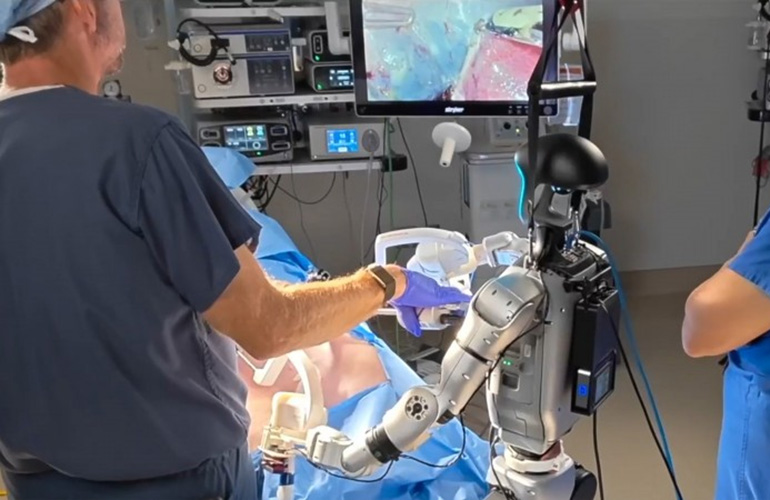
For the first time, teleoperated humanoid robots successfully performed surgeries during a UC San Diego preclinical trial. The post Beyond da Vinci: Why versatile humanoid robots are the next frontier in surgery appeared first on The Robot Report .
The successful teleoperated surgery by humanoid robots in a preclinical trial marks a significant milestone in robotic surgery, moving beyond traditional robotic systems.
This breakthrough suggests a future where humanoid robots could perform complex, versatile tasks in sterile environments, expanding healthcare access and potentially reducing surgical complication rates.
The scope of robotic surgical capabilities is expanding from dedicated systems like da Vinci to more general-purpose, agile humanoid platforms, hinting at a new paradigm for medical automation.
- · Intuitive Surgical
- · Healthcare robotics companies
- · Hospitals and healthcare systems
- · Patients
- · Traditional surgical instrument manufacturers
Teleoperated humanoid robots become an established tool in various surgical specialties, improving precision and reducing human error.
The development of highly skilled robotic surgeons leads to a re-evaluation of medical training and roles for human surgeons, focusing on supervision and advanced cases.
The integration of AI with humanoid surgical robots could lead to fully autonomous surgical systems, raising profound ethical and regulatory questions worldwide.
This signal links to a primary source. Continuum Brief monitors and indexes it as part of the live intelligence stream — we do not republish source content.
Read at The Robot Report