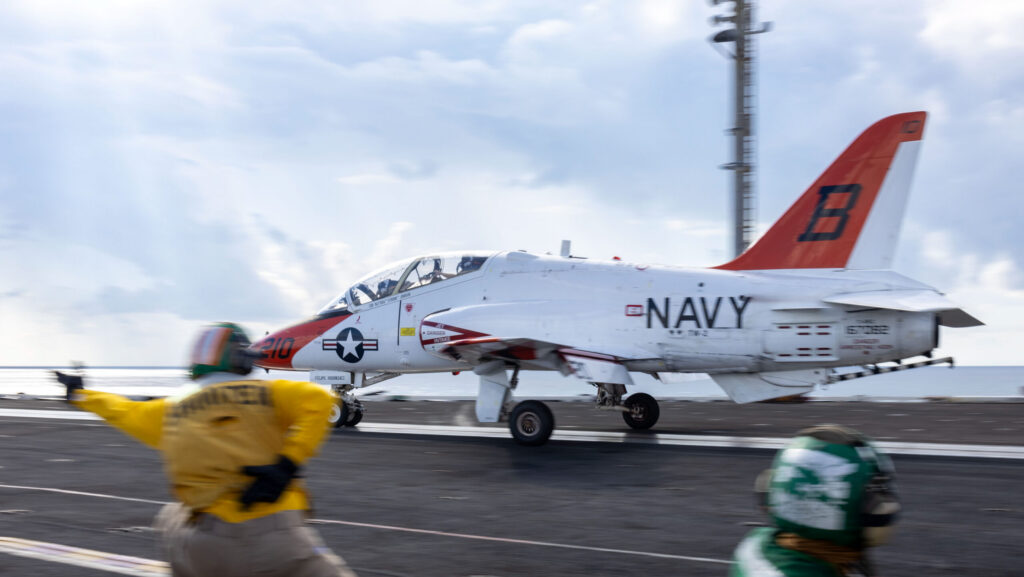
Boeing said the T-7A Red Hawk training jet they are producing for the Air Force doesn’t fulfill Navy requirements.
The decision by Boeing to withdraw from the Navy's trainer jet competition is a direct consequence of their T-7A Red Hawk not meeting specific naval requirements, forcing a strategic realignment.
A strategic reader should care because this highlights the divergence in military branch requirements, possibly leading to increased costs or delays in force modernization, and represents a setback for a major defense contractor.
Boeing is no longer a contender for the Navy's next-generation trainer, shifting the competitive landscape and potentially consolidating market share among remaining bidders.
- · Lockheed Martin
- · SNC
- · Other naval trainer manufacturers
- · Boeing
- · US Air Force (potential commonality loss)
- · US Navy (reduced competition)
The Navy's new trainer jet competition will proceed with fewer bidders, potentially leading to a less competitive contract.
This could prompt other defense contractors to more carefully assess cross-service platform suitability before investing in R&D.
The Air Force may face increased pressure to justify its T-7A Red Hawk platform if the Navy's requirements are seen as more stringent or indicative of future needs.
This signal links to a primary source. Continuum Brief monitors and indexes it as part of the live intelligence stream — we do not republish source content.
Read at Breaking Defense — Air