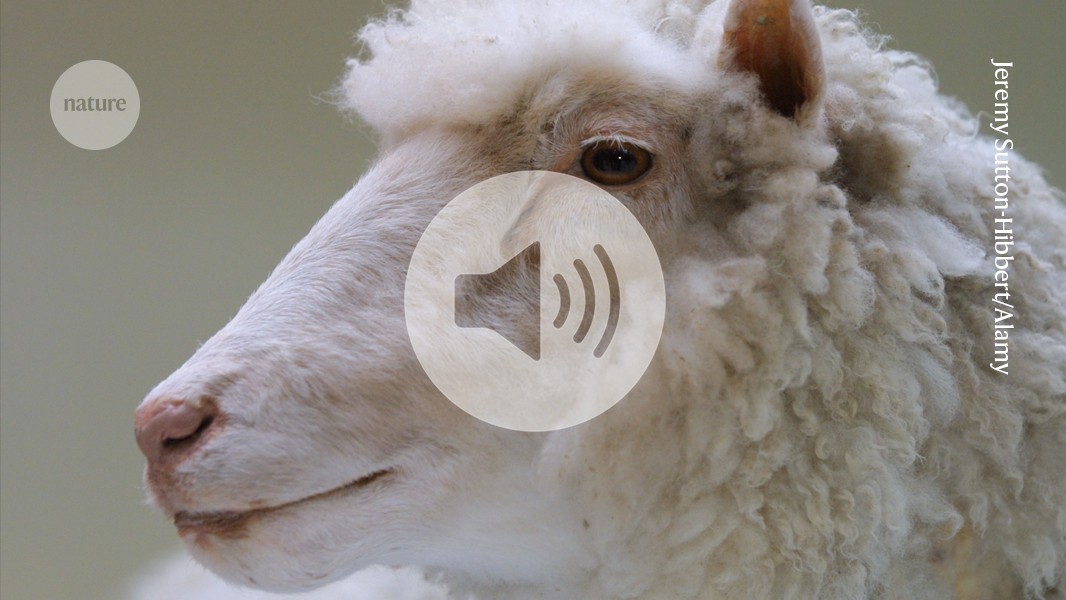
Nature, Published online: 10 July 2026; doi:10.1038/d41586-026-02185-1 Nature staff discuss the landmark moment when a mammal was first cloned from an adult cell — plus, the first direct observation of ocean-floor crust being created.
This briefing reflects on the 30-year legacy of Dolly the sheep, commemorating a landmark moment in reproductive biology and its ongoing implications.
The discussion revisits fundamental breakthroughs in cloning, which continues to inform fields like synthetic biology, genetic engineering, and personalized medicine.
This event itself doesn't change present conditions but serves as a retrospective on how a past scientific achievement profoundly altered our understanding of life sciences and ethical considerations.
- · Biotechnology sector
- · Genetic researchers
- · Medical science
- · Ethical frameworks unprepared for advancements
Ongoing advancements and public discourse in gene editing and cloning techniques.
Increased investment and research into therapies derived from cellular manipulation and programmable biology.
Potential societal re-evaluation of human-animal boundaries and the definition of life in the face of advanced synthetic biology applications.
This signal links to a primary source. Continuum Brief monitors and indexes it as part of the live intelligence stream — we do not republish source content.
Read at Nature — Latest Research