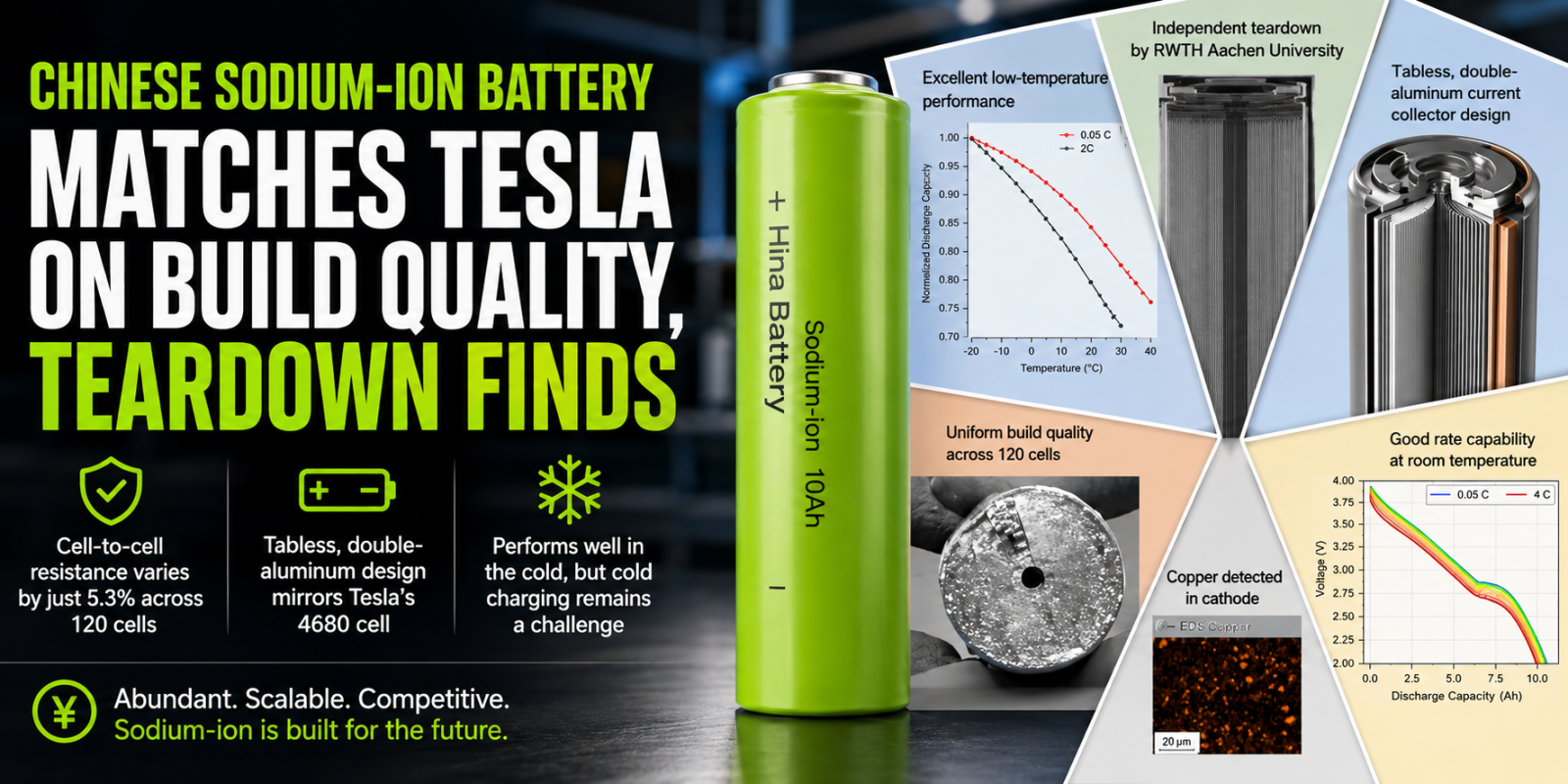
A commercial sodium-ion battery from Chinese manufacturer Hina matches Tesla’s lithium-ion cells on manufacturing quality and internal design, according to an independent teardown published in the Cell Press journal Cell Reports Physical Science . Researchers at Germany’s RWTH Aachen University measured cell-to-cell resistance varying by just 5.3% across 120 cells — a sign of tightly controlled mass production rivaling the best lithium cells on the market.
Advances in materials science and manufacturing techniques are reaching commercial viability for sodium-ion batteries, coinciding with a global push for diversified and sustainable EV battery supply chains.
This development signals a credible alternative to lithium-ion technology, potentially reducing geopolitical dependencies and raw material costs in the EV sector.
The perceived gap in build quality and large-scale manufacturing capability between emerging sodium-ion batteries and established lithium-ion references like Tesla is narrowing significantly.
- · Hina Battery
- · CATL
- · EV manufacturers seeking alternatives to lithium
- · China
- · Lithium miners (long-term)
- · Companies heavily invested in current lithium-ion technology
Increased investment and R&D into sodium-ion battery technology will accelerate its commercial deployment.
Diversification of battery chemistries could stabilize EV production costs and reduce supply chain volatility.
Geopolitical power dynamics related to critical mineral supply chains for EVs may shift, favoring nations with abundant sodium resources.
This signal links to a primary source. Continuum Brief monitors and indexes it as part of the live intelligence stream — we do not republish source content.
Read at Electrek