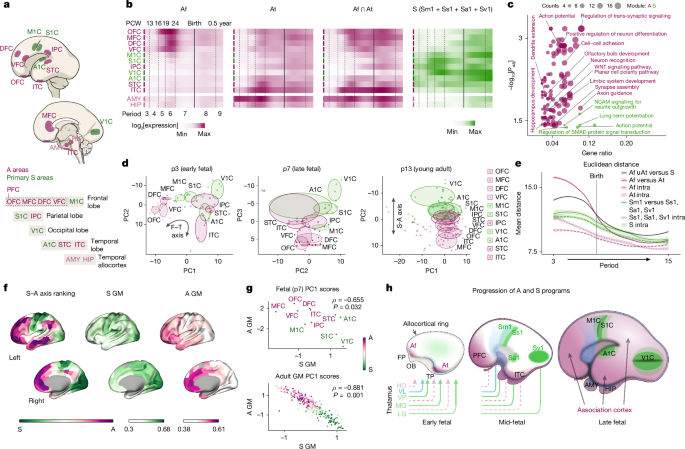
Nature, Published online: 01 July 2026; doi:10.1038/s41586-026-10699-x Multispecies evidence supports the multinodal induction–exclusion in network development model, in which sensorimotor-to-association patterning is governed by competing processes of induction and exclusion driven by two opposing transcriptomically defined programs.
This is a basic science publication from a leading journal, representing ongoing research in neurobiology.
While fundamental to understanding brain development, this specific research on cortical sensorimotor–association axis development does not immediately impact strategic geopolitical or technological considerations.
No immediate or foreseeable changes result from this basic research announcement for a strategic reader.
Further understanding of brain development mechanisms is gained within the scientific community.
This foundational knowledge might eventually contribute to future neurological disorder treatments or artificial intelligence brain-inspired architectures, but this connection is distant.
Very long-term therapeutic advancements or new computational paradigms could theoretically emerge from such basic research, though with no direct line of sight.
This signal links to a primary source. Continuum Brief monitors and indexes it as part of the live intelligence stream — we do not republish source content.
Read at Nature — Latest Research