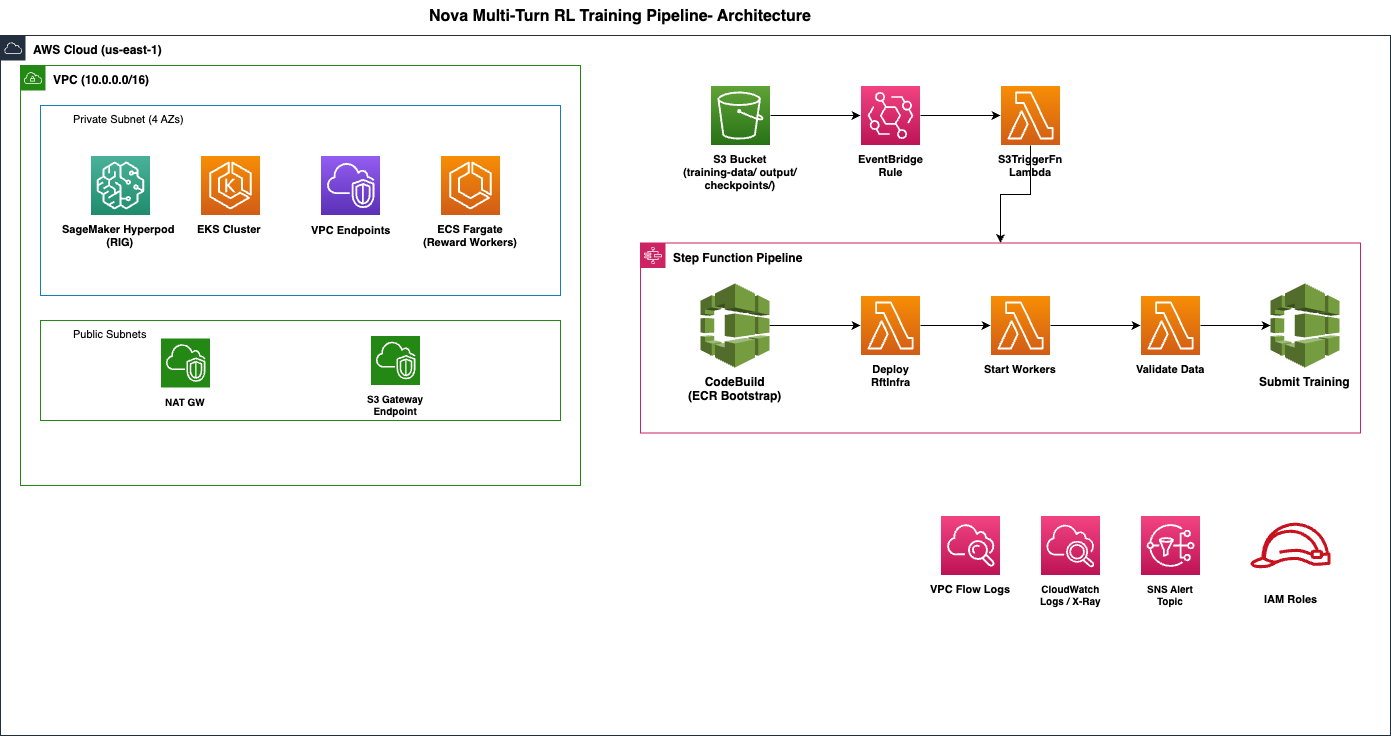
In this post, you deploy a two-phase infrastructure for multi-turn RL using Amazon Nova Forge on Amazon SageMaker HyperPod. By the end, you have an event-driven pipeline that starts training when you upload data to Amazon Simple Storage Service (Amazon S3). The training job teaches the model to play Wordle, a placeholder for your own RL task.
The continuous evolution of AI capabilities, particularly in multi-turn reinforcement learning (RL) and autonomous agents, requires robust and scalable infrastructure for development and deployment.
This development signifies Amazon's commitment to providing advanced, enterprise-grade tools for building sophisticated AI agents, crucial for automating complex tasks and workflows.
Enterprises can now more easily develop and deploy advanced multi-turn reinforcement learning models at scale, potentially accelerating the adoption of AI agents across various sectors.
- · Amazon Web Services (AWS)
- · Enterprises adopting AI agents
- · Machine learning engineers
- · AI software developers
- · Companies offering less scalable AI development platforms
- · Manual process-heavy industries
- · Competitors in AI agent infrastructure
Easier deployment of multi-turn RL models will lead to more complex and capable AI agents.
Increased adoption of these agents could disrupt white-collar workflows and necessitate new skill sets in the workforce.
The proliferation of highly autonomous AI agents might accelerate broader discussions on AI ethics, regulation, and societal integration.
This signal links to a primary source. Continuum Brief monitors and indexes it as part of the live intelligence stream — we do not republish source content.
Read at AWS Machine Learning Blog