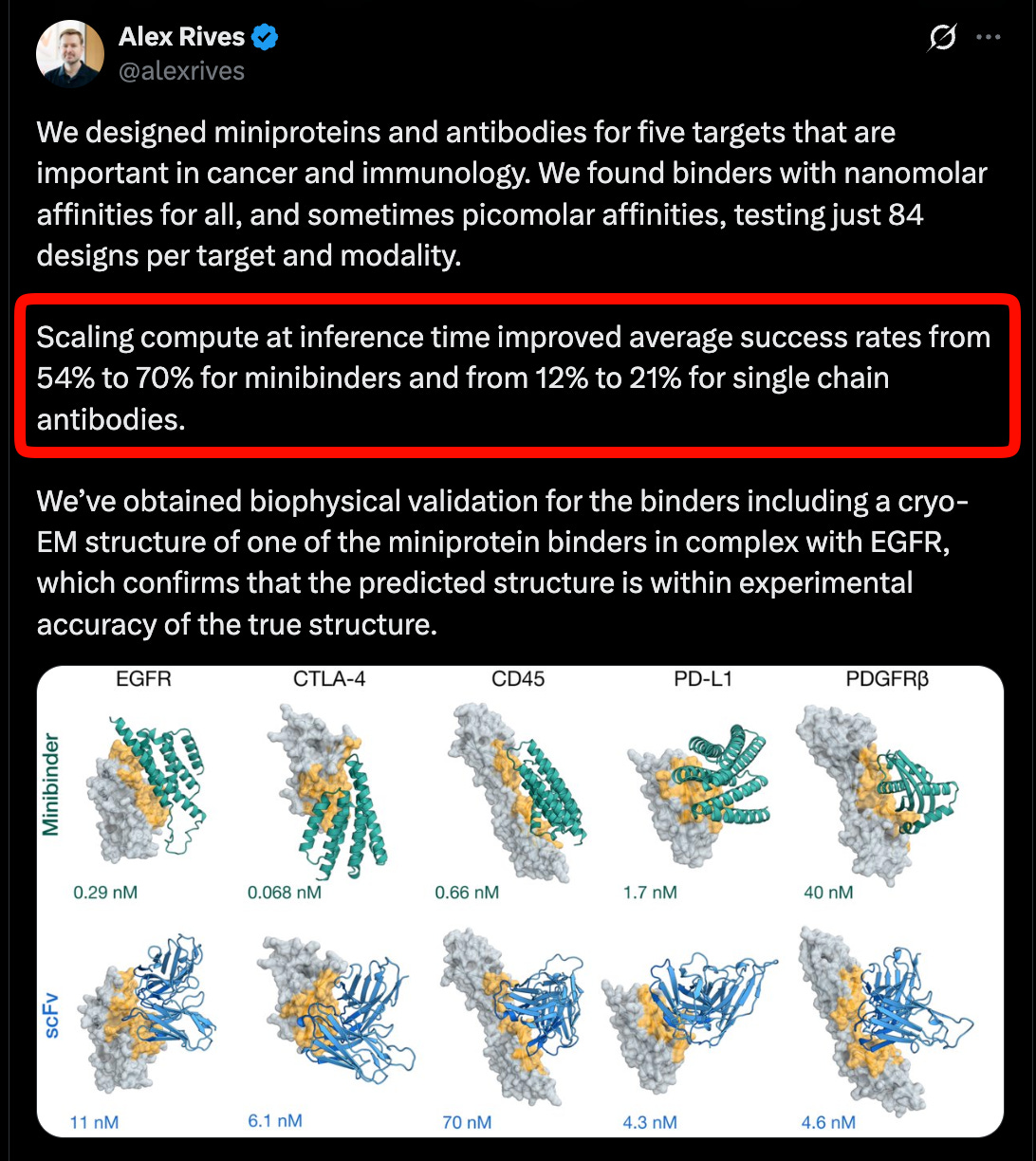
Datasets vs. inductive bias, world models, and programmable biology
The proliferation of large language models and foundation models is demonstrating the power of large datasets and compute for complex problems, now extending to biological systems.
This development signals a significant leap in understanding and manipulating biological structures, potentially unlocking new frontiers in medicine, materials science, and bioengineering.
The ability to predict and design proteins with unprecedented accuracy shifts the paradigm from trial and error to data-driven, programmable biology.
- · Biotech companies
- · Pharmaceutical industry
- · Researchers in synthetic biology
- · AI compute providers
- · Traditional drug discovery methods
- · Companies reliant on slow, iterative biological engineering
- · Labs with limited access to large datasets and compute
Accelerated discovery of novel proteins for therapeutic and industrial applications.
Enabled design of entirely new biological systems and functions, leading to transformative biotechnologies.
Potential for new ethical and regulatory challenges concerning the creation of artificial life forms and their environmental impact.
This signal links to a primary source. Continuum Brief monitors and indexes it as part of the live intelligence stream — we do not republish source content.
Read at Latent Space