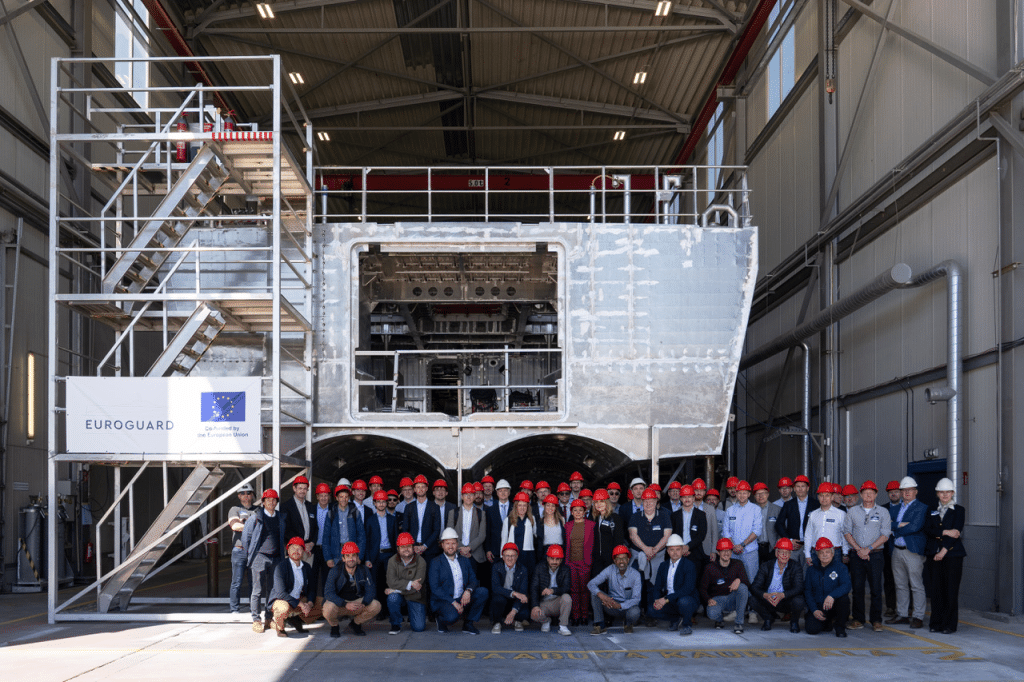
The European Defence Fund’s (EDF) €95 million EUROGUARD program has completed its Critical Design Review (CDR) and unveiled its 45-meter semi-autonomous prototype hull at the Baltic Workboats shipyard in Estonia. On May 21, 2026, EUROGUARD project marked a major milestone at the Baltic Workboats shipyard in Nasva, Estonia, hosting its Critical Design Review (CDR) alongside the prototype ... The post EUROGUARD M-SASV Project Moves From Design To Reality With Hull Presentation appeared first on Naval News .
The EUROGUARD project has completed its Critical Design Review and unveiled a prototype hull, signifying a tangible step from design to reality in European defence autonomy, driven by the European Defence Fund.
This development indicates a concrete advancement in Europe's capability to deploy indigenous uncrewed surface vessels (USVs), reducing reliance on traditional naval assets and enhancing maritime security with autonomous systems.
The presentation of a 45-meter semi-autonomous prototype hull means that a significant, large-scale USV is moving closer to operational deployment within the European theatre, potentially altering future naval acquisition strategies.
- · European defence contractors
- · Naval drone technology developers
- · Baltic Workboats shipyard
- · European navies
- · Traditional crewed vessel manufacturers
- · Submarine warfare systems relying solely on manned platforms
The EUROGUARD M-SASV project will progress to sea trials and further development, validating autonomous maritime capabilities.
Increased adoption of large-scale USVs in Europe could lead to a restructuring of naval budgets and force compositions across member states.
Successful deployment of EUROGUARD could prompt other global naval powers to accelerate their own large autonomous surface vessel programs, intensifying the naval drone arms race.
This signal links to a primary source. Continuum Brief monitors and indexes it as part of the live intelligence stream — we do not republish source content.
Read at Naval News