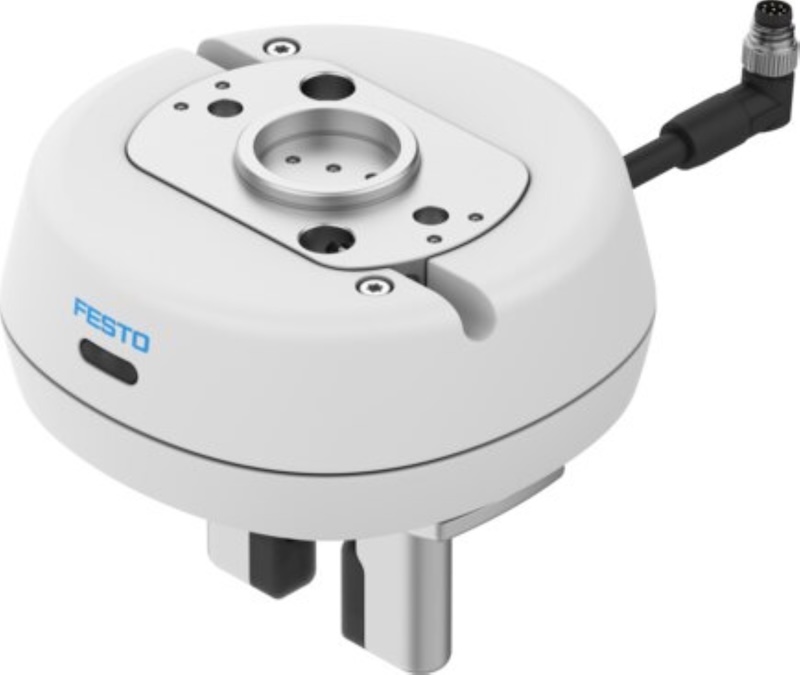
Collaborative robots operate within strict payload and mounting constraints. Pneumatic gripper installations that rely on external valves, sensors, and wiring add weight, increase footprint, and complicate routing along compact cobot arms. To address these constraints, Festo has introduced the HPPH two-finger pneumatic parallel gripper, a compact, lightweight design that integrates control, sensing, and collaborative safety […]
The continuous drive for greater efficiency and adaptability in manufacturing, coupled with the increasing adoption of collaborative robots, creates demand for more integrated and compact peripheral components.
This development addresses key limitations in cobot integration, making them more versatile and easier to deploy in various industrial settings, accelerating factory automation.
Cobot gripper installations can now be more compact, lightweight, and simpler, reducing complexity and increasing the range of applications for collaborative robotics.
- · Festo
- · Collaborative Robotics Manufacturers
- · Factory Automation Sector
- · SMEs adopting automation
- · Manufacturers of bulky, multi-component pneumatic systems
Increased adoption of collaborative robots in tighter spaces and more complex handling tasks due to integrated gripper technology.
Faster ROI for businesses deploying cobots as integration costs and complexity decrease, broadening market penetration.
Accelerated development of fully integrated, 'plug-and-play' robotic solutions that blur the lines between robot arm and end effector functionality.
This signal links to a primary source. Continuum Brief monitors and indexes it as part of the live intelligence stream — we do not republish source content.
Read at Robotics & Automation News