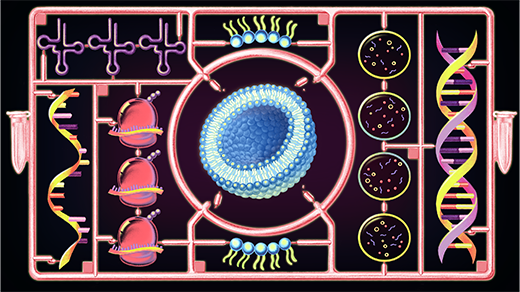
Scientists built a synthetic cell that combines more lifelike properties than ever before — proof of concept that it’s possible to bring nonliving materials to life, or something close to it, in the lab. The post For the First Time, a Cell Built From Scratch Grows and Divides first appeared on Quanta Magazine
Advances in synthetic biology and computational power have finally converged to allow for the creation of more complex, self-replicating synthetic biological systems.
This development represents a fundamental step towards understanding and engineering life itself, with profound implications for medicine, materials science, and industrial production.
The ability to construct a growing and dividing synthetic cell demonstrates a new level of control over biological processes outside of naturally evolved systems.
- · Biotech companies
- · Pharmaceutical research
- · Materials science
- · Academic research institutions
- · Traditional manufacturing
- · Resource-intensive industries
Proof of concept for de novo creation of life-like systems accelerates research into designer cells for various applications.
The ethical and philosophical implications of creating synthetic life will become a more prominent societal debate.
Long-term, this could lead to living factories capable of producing complex outputs with unprecedented efficiency and specificity.
This signal links to a primary source. Continuum Brief monitors and indexes it as part of the live intelligence stream — we do not republish source content.
Read at Quanta Magazine