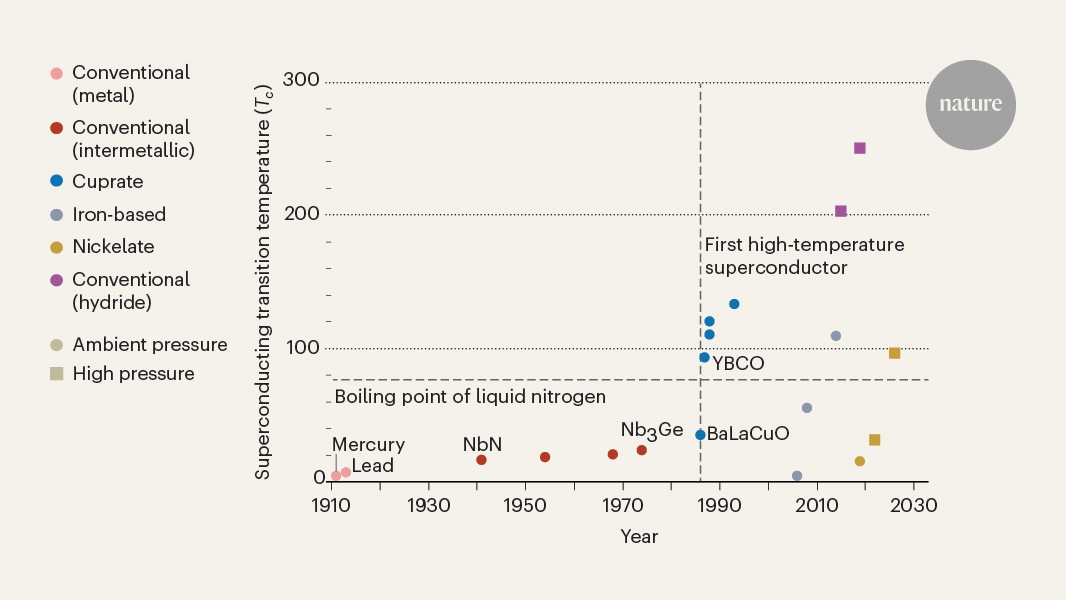
Nature, Published online: 22 June 2026; doi:10.1038/d41586-026-01801-4 The first demonstration of superconductivity at 35 kelvin drove decades of materials research and introduced a puzzle about this strange state of matter.
The article marks 40 years since the initial demonstration of high-temperature superconductivity, signaling a mature field with ongoing research and potential breakthroughs.
Achieving room-temperature superconductivity could revolutionize energy transmission, computing, and various industrial applications, fundamentally altering infrastructure and supply chains.
Continued progress in understanding and developing high-temperature superconductors brings closer the possibility of widespread practical applications, reducing energy loss and enabling new technologies.
- · Energy companies
- · Semiconductor industry
- · Materials science research
- · Quantum computing
- · Traditional energy transmission infrastructure
- · Current cooling technologies
Further research and investment in high-temperature superconductivity materials will likely accelerate.
Breakthroughs could lead to the development of highly efficient power grids and miniaturized, powerful electronic devices.
A fully superconductive technological stack could profoundly impact geopolitical power dynamics and economic competitiveness by dramatically improving energy efficiency.
This signal links to a primary source. Continuum Brief monitors and indexes it as part of the live intelligence stream — we do not republish source content.
Read at Nature — Latest Research