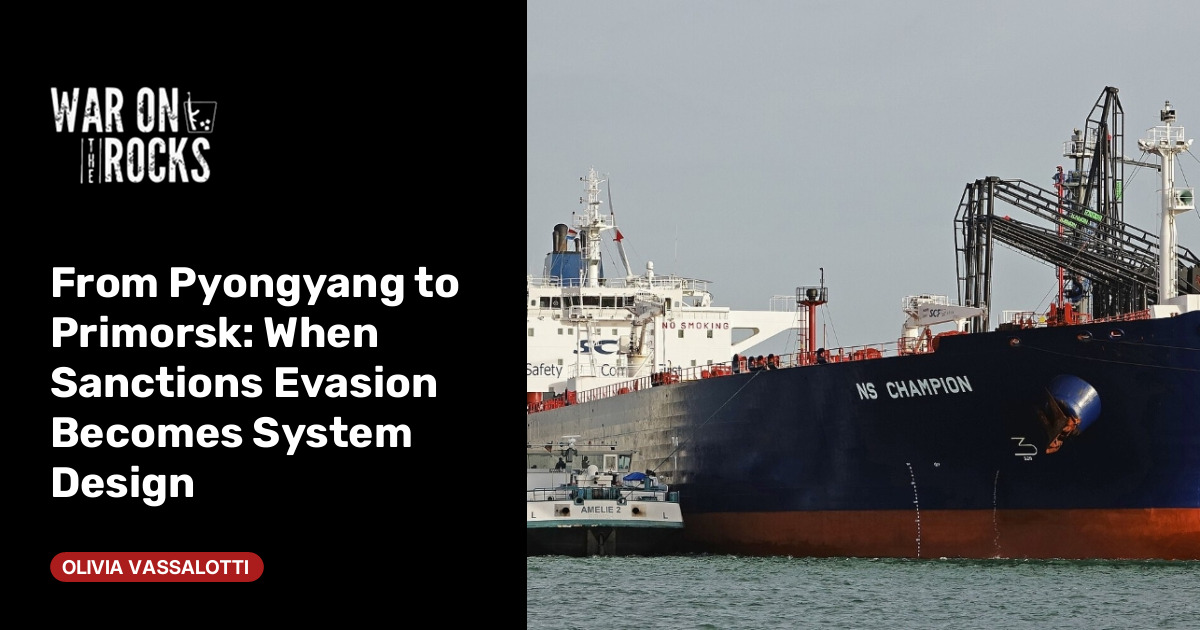
Rarely a week passes without a new story about Russia’s shadow fleet. Tankers catch fire in the Mediterranean, are added to sanctions lists, or are boarded while passing through European waters. But the bigger story is not the vessels that are caught, but those that aren’t — ships moving between registries, ports, shell companies, and service providers that obscure their ties to Russia while keeping a sanctioned state afloat. The vessels that do get sanctioned are the visible tip of a larger scheme that North Korea spent years running, and Russia has refined at scale.Shadow fleets are typicall
The proliferation of shadow fleets demonstrates the evolving nature of sanctions evasion, driven by geopolitical tensions and states actively working to circumvent international restrictions.
Sophisticated sanctions evasion techniques, particularly through shadow fleets, undermine international policy instruments and enable state actors to sustain prohibited activities, impacting global stability and economic order.
The effectiveness of sanctions is increasingly challenged by state-sponsored, systematic evasion, shifting the focus from individual breaches to designing more robust and dynamic enforcement mechanisms.
- · Russia
- · North Korea
- · Sanctions evasion facilitators
- · Sanctioning nations
- · Legitimate maritime shipping
- · Global financial transparency
Ongoing circumvention of sanctions by Russia and its allies through complex maritime logistics.
Increased pressure on international bodies to develop more sophisticated counter-evasion strategies and enforcement tools.
The potential for a two-tiered global economy, with a compliant system and a parallel shadow system for sanctioned actors.
This signal links to a primary source. Continuum Brief monitors and indexes it as part of the live intelligence stream — we do not republish source content.
Read at War on the Rocks