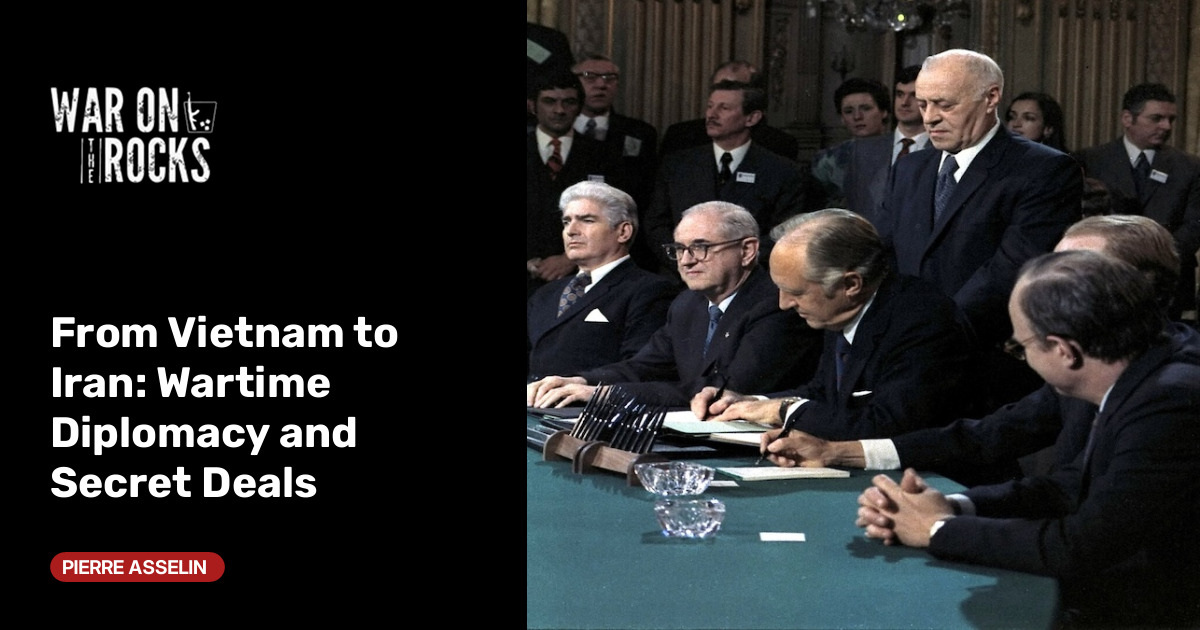
Wars rarely end in a single act of diplomacy. More often, they pass through a succession of ceasefires, frameworks, understandings, as well as provisional and even secret arrangements before anyone can determine whether peace is actually at hand. The Trump administration’s memorandum with Iran is best understood in those terms. In both form and logic, it recalls an earlier American effort to negotiate an exit from an unpopular conflict: the Paris Peace Accords of 1973.The four primary parties to the Vietnam War (1965 to 1975) — the United States, South Vietnam, North Vietnam, and the Provision
The article's publication coinciding with 'Iran War 2026' suggests a contemporary urgency to re-evaluate diplomatic strategies for conflict resolution, especially given the Trump administration's past engagement with Iran.
This analysis draws a parallel between current diplomatic efforts and historical precedents like the Paris Peace Accords, offering a framework for understanding the complex, multi-stage process of ending conflicts.
The understanding that major conflicts often conclude not with a single decisive act, but through a series of provisional and secret arrangements, shifts expectations for conflict resolution in ongoing geopolitical tensions.
- · Diplomats
- · Negotiators
- · International relations strategists
- · Actors seeking immediate, decisive conflict endings
- · Hardline factions unwilling to engage in layered diplomacy
Ongoing conflicts, such as those potentially involving Iran, will likely follow a similar multi-stage, obscured diplomatic path toward resolution.
Public and political expectations around conflict termination may slowly adjust to embrace a more nuanced, prolonged, and incremental diplomatic process.
This nuanced view of conflict resolution could encourage more back-channel communications and less public posturing in future international disputes.
This signal links to a primary source. Continuum Brief monitors and indexes it as part of the live intelligence stream — we do not republish source content.
Read at War on the Rocks