GitOps in Practice: How to Design a Scalable CI/CD Pipeline with GitLab and GKE
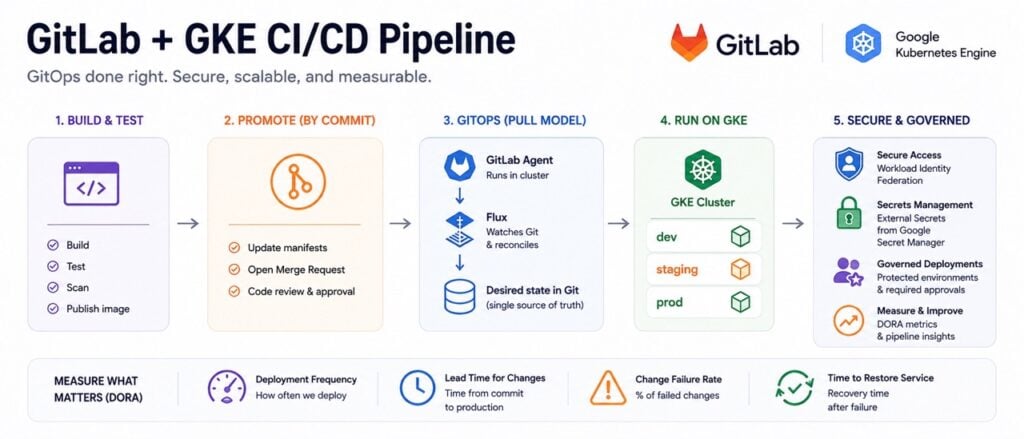
A scalable CI/CD pipeline on GitLab and Google Kubernetes Engine starts with one decision: do you treat the pipeline as a delivery system you design, or as a YAML file you copy from a tutorial? Most teams default to the second. They wire up a .gitlab-ci.yml, push to a cluster, The post GitOps in Practice: How to Design a Scalable CI/CD Pipeline with GitLab and GKE appeared first on Cloud Native Now .
The continuous evolution of cloud-native development and the increasing complexity of software deployments necessitate more robust and scalable CI/CD practices, making GitOps a timely and practical solution.
This guidance on GitOps for scalable CI/CD pipelines highlights best practices for infrastructure-as-code and automated deployments, which are crucial for maintaining agility and reliability in modern software development.
Approaches to CI/CD are shifting from ad-hoc setups to more declarative, Git-centric models, standardizing deployment processes and enhancing operational consistency.
- · DevOps teams
- · Cloud infrastructure providers
- · Enterprises adopting cloud-native architectures
- · Manual deployment processes
- · Legacy CI/CD tools
Increased adoption of GitOps practices across organizations leveraging Kubernetes and GitLab.
Greater efficiency in software delivery cycles and reduced human error in infrastructure management.
Potential for further automation and AI integration into GitOps workflows, creating hyper-converged development and operations platforms.
This signal links to a primary source. Continuum Brief monitors and indexes it as part of the live intelligence stream — we do not republish source content.
Read at Container Journal