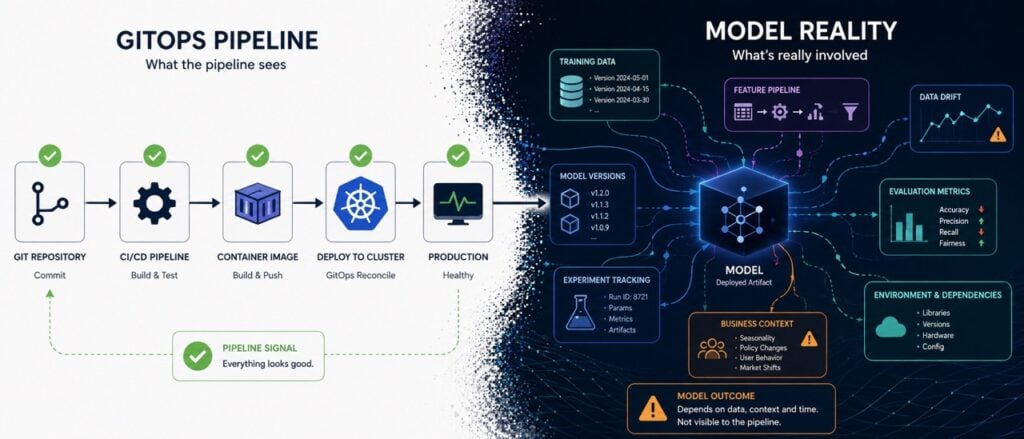
GitOps won the deployment argument. Everything goes in Git, the cluster reconciles itself to match, and your repository becomes the one place that tells you what’s actually running. It’s clean and auditable and, for normal services, it just works. Then somebody runs a machine learning model through the same pipeline, The post GitOps Wasn’t Built for Models, and It Shows appeared first on Cloud Native Now .
The increasing adoption of AI and machine learning models in production environments is exposing the limitations of existing MLOps and GitOps workflows, prompting a need for specialized solutions.
The mismatch between traditional infrastructure-as-code practices (GitOps) and the dynamic, data-intensive requirements of AI models creates significant operational friction and bottlenecks for model deployment and management.
The focus shifts from general-purpose infrastructure deployment to specialized MLOps platforms and practices that can accommodate the unique lifecycle and computational demands of AI models.
- · MLOps platform providers
- · Data scientists
- · Cloud infrastructure providers optimized for AI
- · Generic GitOps tools without MLOps extensions
- · Organizations with siloed AI and infrastructure teams
The article highlights the operational challenges of deploying and managing AI models using traditional GitOps approaches.
This will drive the development and adoption of tailored MLOps solutions that better integrate with and extend existing infrastructure practices.
The bifurcation of deployment strategies for traditional software and AI models could lead to more complex enterprise IT landscapes, requiring new forms of orchestration or converged platforms in the long term.
This signal links to a primary source. Continuum Brief monitors and indexes it as part of the live intelligence stream — we do not republish source content.
Read at Container Journal