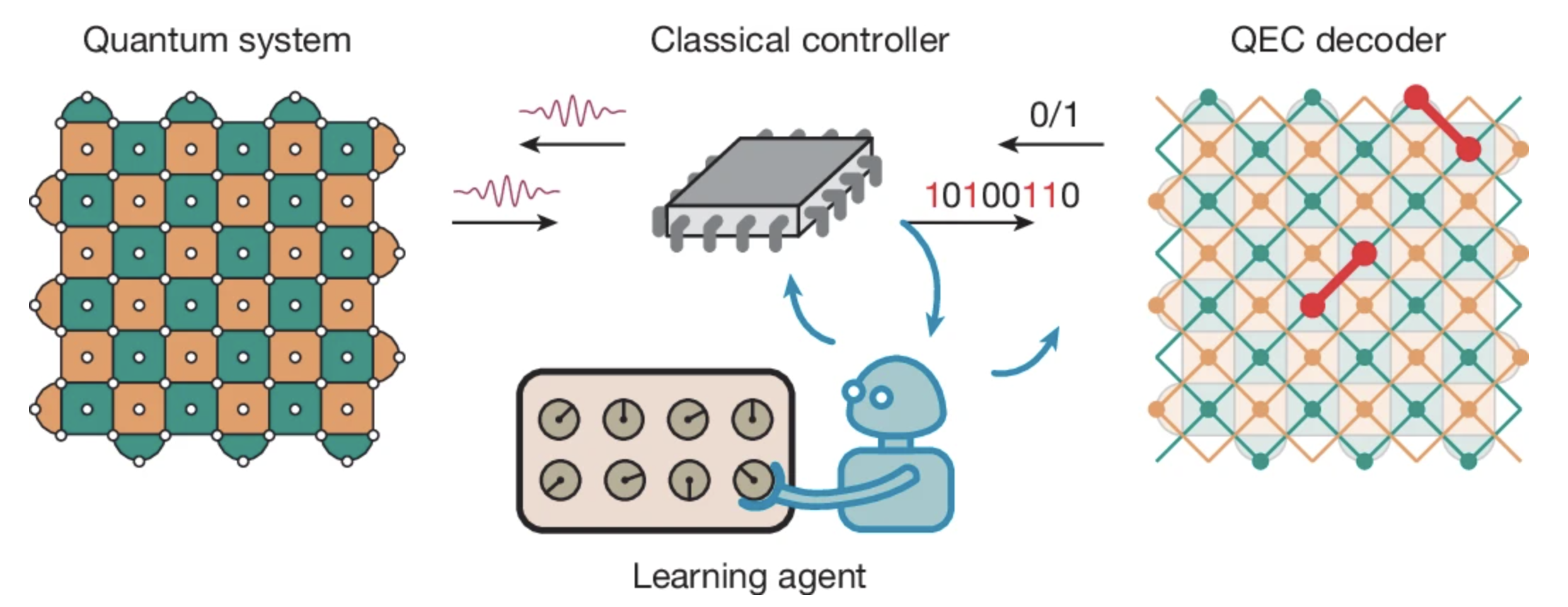
Insider Brief A Google-led research team has demonstrated a quantum computer that continuously learns from its own errors while it is running, replacing one of the biggest operational bottlenecks in quantum computing with an artificial intelligence system that adapts as conditions change. The study, published in Nature, describes a reinforcement learning system that uses the […]
This development comes as quantum computing research continues to mature, with a significant focus on overcoming foundational challenges like error correction to achieve practical quantum advantage.
This breakthrough addresses a critical bottleneck in quantum computing, making fault-tolerant quantum computers more feasible and accelerating the timeline for real-world applications.
The ability of a quantum computer to self-correct errors in real-time, using AI, fundamentally changes the approach to building scalable and reliable quantum systems.
- · Quantum computing researchers
- · AI-driven error correction component manufacturers
- · Industries reliant on complex computational problems
- · Conventional error correction methods
- · Competitors without similar AI integration
- · Less resilient quantum computing architectures
The immediate first-order effect is a significant acceleration in the development of practical, fault-tolerant quantum computers.
A plausible second-order consequence is the widening of the lead for companies capable of integrating advanced AI with their quantum hardware.
A speculative but reasoned third-order consequence is the emergence of new quantum algorithms and applications that were previously considered intractable due to error sensitivity.
This signal links to a primary source. Continuum Brief monitors and indexes it as part of the live intelligence stream — we do not republish source content.
Read at The Quantum Insider