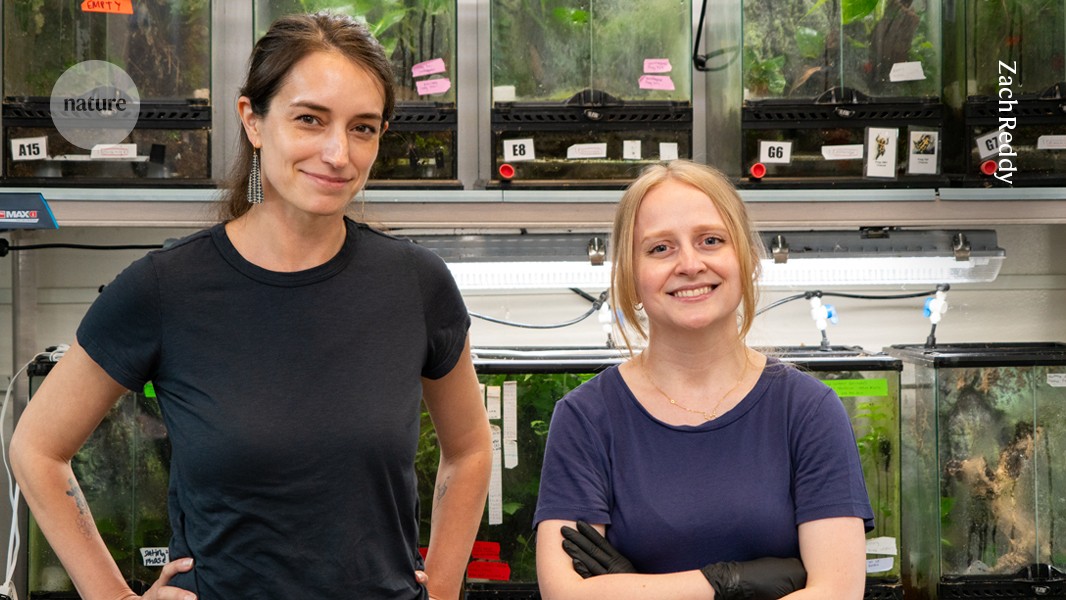
Nature, Published online: 25 May 2026; doi:10.1038/d41586-026-01621-6 Billie Goolsby’s experience with hearing loss helped her to develop a robotic tadpole for deciphering the secret lives of amphibians.
The development of a robotic tadpole for deciphering amphibian communication reflects ongoing advancements in biomimicry and robotics, driven by new engineering capabilities and scientific curiosity.
This breakthrough represents a novel application of robotics for ecological study, providing new tools for understanding complex biological systems and potentially informing biomimetics or environmental monitoring.
The ability to 'eavesdrop' on amphibian conversations through a biomimetic robot changes how ecological research can be conducted, offering less intrusive and more detailed data collection methods.
- · Ecological researchers
- · Robotics engineers
- · Conservation science
- · Biomimicry applications
- · Traditional invasive monitoring methods
- · Researchers reliant on manual observation
More accurate and comprehensive data will be collected on amphibian behavior and communication patterns.
Understanding amphibian communication might lead to bio-inspired communication technologies or environmental sensing systems.
The technology could be adapted to monitor other sensitive species or environments, facilitating broader biodiversity conservation efforts.
This signal links to a primary source. Continuum Brief monitors and indexes it as part of the live intelligence stream — we do not republish source content.
Read at Nature — Latest Research