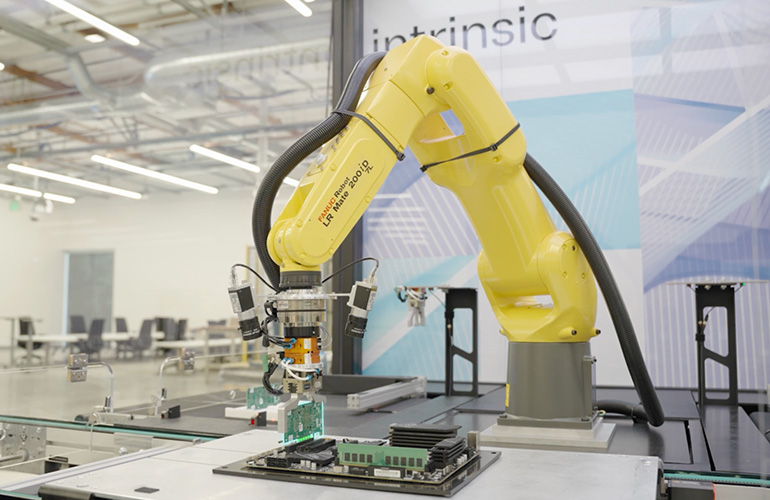
Alphabet’s Intrinsic has debuted its AI-powered "Intelligence Cell" to simplify factory automation and eliminate complex robot programming. The post How Intrinsic eliminates manual robot coding appeared first on The Robot Report .
The increasing sophistication of AI models and the demand for greater automation in manufacturing are converging to enable solutions that simplify previously complex robot programming.
This development significantly lowers the barrier to entry for advanced robotics adoption in manufacturing, potentially accelerating automation across various industries and reducing reliance on specialized programming skills.
Robot programming is shifting from laborious manual coding to more accessible, AI-powered intuitive methods, making automation viable for a wider range of tasks and businesses.
- · Intrinsic
- · FANUC
- · Manufacturing sector
- · Small and medium enterprises
- · Manual robot programmers
- · Companies reliant on traditional, complex robot integration
- · Labor-intensive assembly operations
Widespread adoption of industrial robots becomes economically and operationally more feasible for a broader range of manufacturers.
Increased automation drives productivity gains and potentially leads to reshoring of manufacturing due to reduced labor costs.
The definition of 'skilled labor' in manufacturing evolves, focusing more on AI oversight and maintenance rather than direct programming.
This signal links to a primary source. Continuum Brief monitors and indexes it as part of the live intelligence stream — we do not republish source content.
Read at The Robot Report