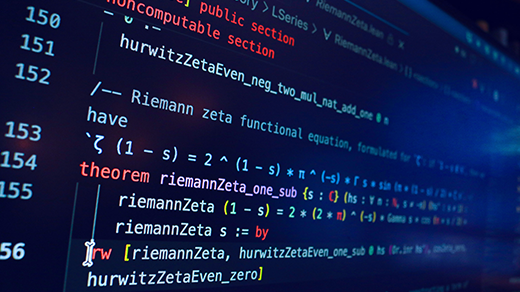
With automated proof-checkers, a problem can be broken up into small chunks, solved bit-by-bit, then reassembled with confidence that every piece is correct. For some, this heralds a new area in mathematical research. The post How Terry Tao Became an Evangelist for AI in Math first appeared on Quanta Magazine
The accelerating capabilities of AI in complex reasoning tasks, particularly in mathematical proof generation and verification, makes this development timely.
The integration of AI in foundational mathematical research could revolutionize the pace of discovery and the nature of proof, impacting scientific progress broadly.
Mathematical research methodologies will increasingly incorporate AI tools for proof-checking and potential discovery, shifting away from purely human-led verification.
- · AI research institutions
- · Mathematics community
- · Software developers for AI in math
- · Academic publishers
- · Traditional proof verification methods
- · Mathematicians resistant to AI tools
AI tools become commonplace in advanced mathematical research and publication.
The pace of mathematical breakthroughs accelerates, leading to new scientific and technological applications.
The very definition of mathematical truth and human understanding in proofs may evolve through human-AI collaboration.
This signal links to a primary source. Continuum Brief monitors and indexes it as part of the live intelligence stream — we do not republish source content.
Read at Quanta Magazine