Human-Robot Collaboration: How Modern Workplaces Can Be Designed for Safety, Productivity, and Employee Wellbeing
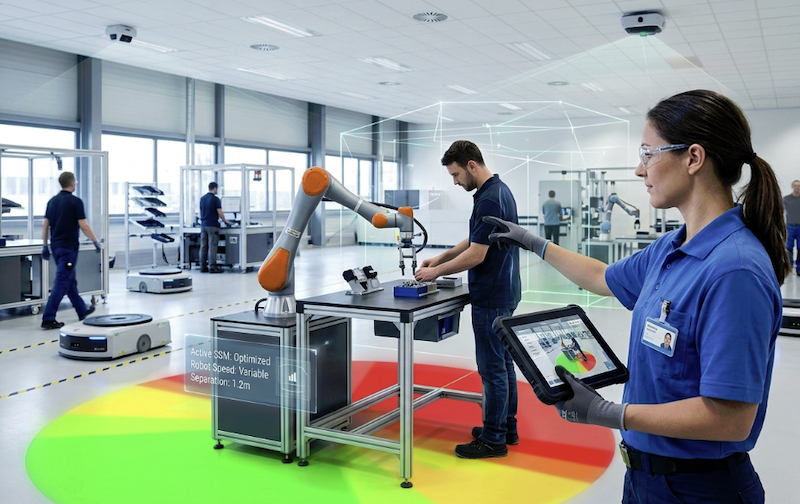
Physical barriers are disappearing from the modern production floor, with the $85 billion industrial robotics market creating a shared environment where people and machinery work side by side. Successfully managing this transition requires a deep understanding of spatial geometry, workforce psychology, and functional safety standards. There are millions of industrial robots deployed worldwide, and each […]
The industrial robotics market is rapidly expanding, creating a larger shared environment between humans and machines, necessitating advanced strategies for integration.
The shift towards human-robot collaboration impacts productivity, safety, and employee well-being in critical industrial sectors, reshaping manufacturing and labor dynamics.
The design of industrial workplaces is evolving beyond physical barriers, requiring new approaches to spatial geometry, psychology, and safety standards for effective human-robot interaction.
- · Industrial automation companies
- · Robotics manufacturers
- · Workplace safety consultants
- · Employee wellbeing solution providers
- · Companies slow to adopt automation
- · Sectors reliant on purely manual labor
Increased demand for specialized training and skills in robotics integration and human-robot interaction.
Potential for new regulatory frameworks and safety standards specifically designed for collaborative industrial environments.
Long-term societal shifts in labor identity and job roles as human-robot collaboration becomes ubiquitous across industries.
This signal links to a primary source. Continuum Brief monitors and indexes it as part of the live intelligence stream — we do not republish source content.
Read at Robotics & Automation News