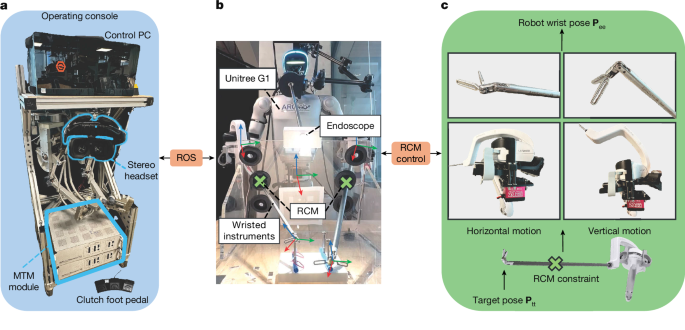
Nature, Published online: 08 July 2026; doi:10.1038/s41586-026-10796-x A systematic evaluation shows that contemporary humanoid robots can perform laparoscopic surgical tasks through teleoperation, highlighting both their promise and key technical challenges before clinical deployment.
Advances in robotics and AI are converging, enabling more sophisticated autonomous and teleoperated systems suitable for complex tasks like surgery.
The successful in vivo application of humanoid robots in surgery indicates a significant step towards their commercial viability and redefines the potential scope of automated labor in high-stakes fields.
The feasibility of humanoid robots for surgical tasks changes the timeline for their clinical deployment, accelerating the need for regulatory frameworks, ethical guidelines, and specialized surgical training.
- · Robotics companies
- · Healthcare providers
- · Automation software developers
- · Patients in remote areas
- · Traditional medical device manufacturers (slow adopters)
- · Unskilled labor in healthcare support
- · Surgeons unwilling to adapt to teleoperation platforms
Increased investment and R&D in humanoid robot design and surgical AI for enhanced precision and autonomy.
Revision of medical training curricula to include teleoperation and human-robot collaborative surgical techniques.
Transformation of healthcare delivery models, potentially decentralizing advanced surgical care and reducing costs through automation.
This signal links to a primary source. Continuum Brief monitors and indexes it as part of the live intelligence stream — we do not republish source content.
Read at Nature — Latest Research