Inside Target’s LLM-Based System for Semantic Matching in Marketing Forecast Pipelines
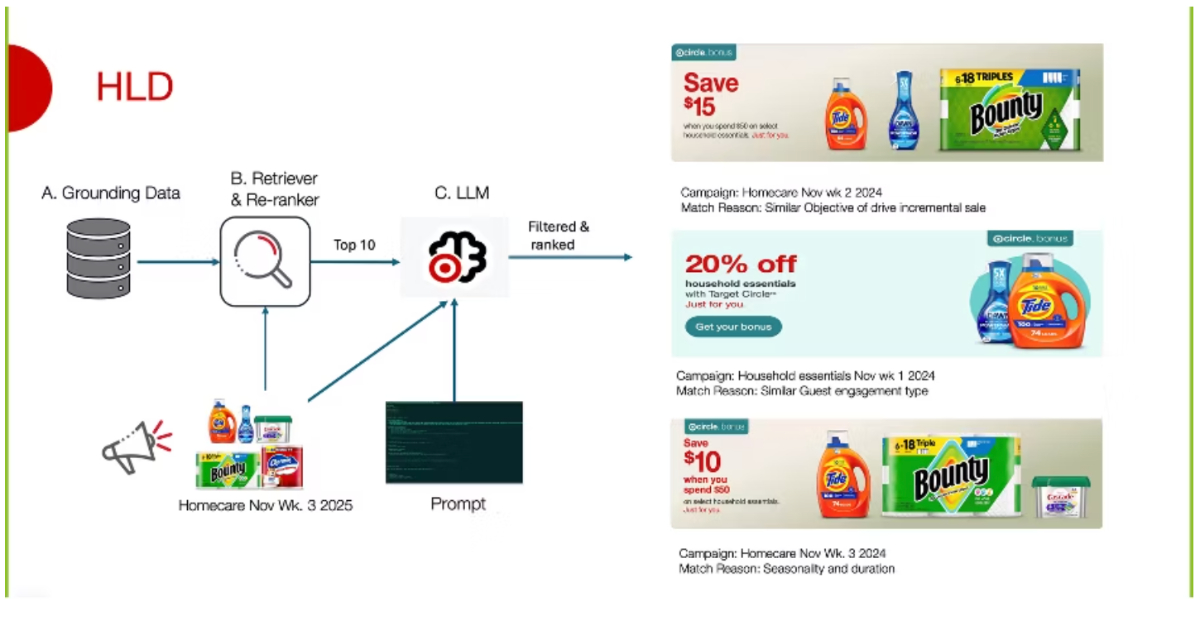
Target built a generative AI system to improve marketing campaign forecasting by retrieving and ranking similar historical campaigns. Using embeddings, vector search, and LLM ranking, it replaces rule-based workflows. Evaluation shows 75% top-1 and 100% top-3 coverage. The system reduces manual effort, improves consistency, and uses feedback loops to refine retrieval using campaign outcomes. By Leela Kumili
The rapid advancement and accessibility of LLM technology, combined with the need for improved efficiency in marketing, are driving the adoption of such systems.
This development showcases how large retailers are directly integrating advanced AI, specifically LLMs and vector databases, into core operational workflows, moving beyond hype to concrete applications.
Manual, rule-based marketing forecasting processes are being replaced by adaptive, AI-driven systems that promise higher accuracy and efficiency through semantic matching and learning loops.
- · Retailers adopting advanced AI
- · AI platform providers
- · Data analytics and MLOps sectors
- · Legacy marketing software providers
- · Businesses slow to adopt AI-driven forecasting
Target gains significant competitive advantage in marketing efficiency and campaign return on investment.
This success prompts widespread adoption of similar LLM-based systems across other retail functions and industries.
The integration of AI agents across enterprise operations leads to a significant transformation of white-collar work and a re-evaluation of human-AI collaboration models.
This signal links to a primary source. Continuum Brief monitors and indexes it as part of the live intelligence stream — we do not republish source content.
Read at InfoQ