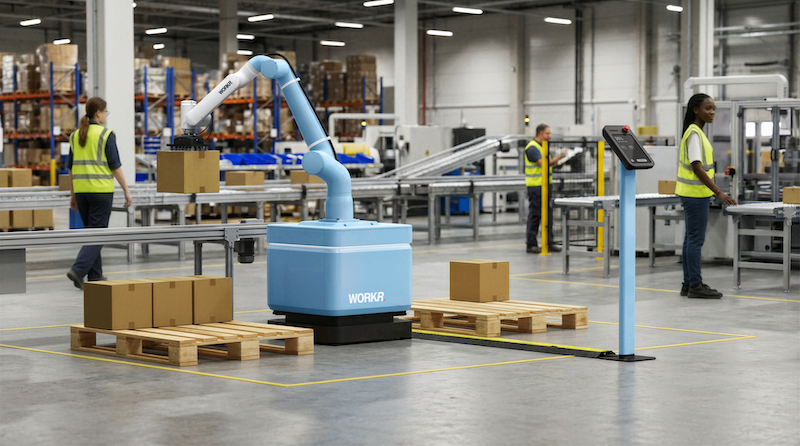
Industrial robotics is entering a new phase. Advances in artificial intelligence, large language models, and so-called embodied AI have sparked renewed excitement about robots that can understand, reason about, and interact with the physical world. High-profile collaborations between companies such as Google DeepMind and Boston Dynamics have fueled speculation that increasingly capable general-purpose robots may […]
Advances in AI, LLMs, and embodied AI are making industrial robots more capable of understanding and interacting with the physical world, pushing the technology into a new phase of commercial viability.
The interview highlights how AI-driven robotics is transforming industrial automation, moving beyond fixed-task robots to more flexible, general-purpose machines accessible through new business models like 'automation by the hour.'
Industrial robots are evolving from specialized, high-capex investments to adaptable, AI-powered systems potentially offered as a service, significantly broadening their adoption and impact across various sectors.
- · Workr Robotics
- · Boston Dynamics
- · Automation integrators
- · Manufacturing sector
- · Traditional fixed-automation providers
- · Certain low-skill manual labor
- · Companies slow to adopt automation
Increased adoption of AI-driven industrial robots in various manufacturing and logistics settings.
A shift in business models for robotics, moving towards subscription or 'as-a-service' offerings, democratizing access to advanced automation.
Significant productivity gains and reshoring of manufacturing capabilities for regions embracing these advanced robotic solutions.
This signal links to a primary source. Continuum Brief monitors and indexes it as part of the live intelligence stream — we do not republish source content.
Read at Robotics & Automation News