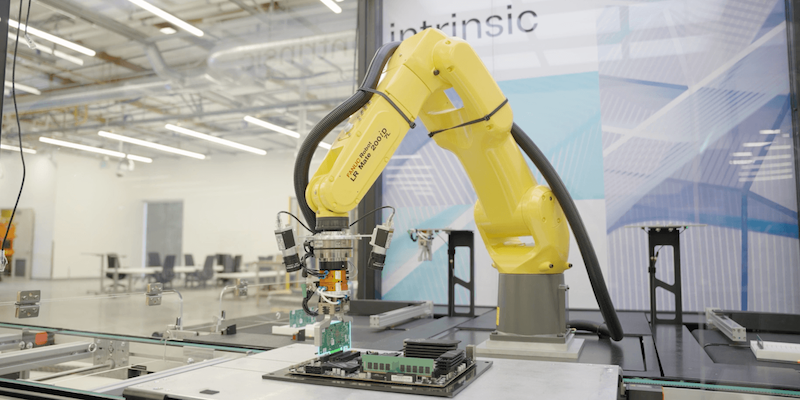
For decades, industrial automation has largely followed the same formula. Production lines have become faster, robots have become more capable, and software has steadily improved, but the underlying model has remained relatively fixed: automation systems are engineered for specific tasks, making flexibility expensive and time-consuming. That model is increasingly being challenged. Manufacturers today are under […]
The increasing sophistication of AI and robotics, coupled with growing demands for production flexibility, is pushing manufacturers to re-evaluate traditional automation models.
A shift towards software-defined factories enables more adaptable and efficient production, which is crucial for competitiveness in a rapidly changing global market.
Automation systems are moving from fixed, task-specific setups to flexible, software-driven solutions that can be rapidly reconfigured to meet evolving production needs.
- · Manufacturers adopting flexible automation
- · AI/Robotics software developers
- · Electronics assembly sector
- · Companies with diverse product lines
- · Traditional industrial automation integrators
- · Factories locked into rigid infrastructure
- · Low-skill assembly labor (in some contexts)
Factories achieve greater agility and reduced retooling costs due to software-defined automation.
This flexibility could accelerate product innovation cycles and enable hyper-customization at scale.
The competitive landscape for manufacturing shifts, favoring nations and companies capable of rapid, software-driven industrial adaptation.
This signal links to a primary source. Continuum Brief monitors and indexes it as part of the live intelligence stream — we do not republish source content.
Read at Robotics & Automation News