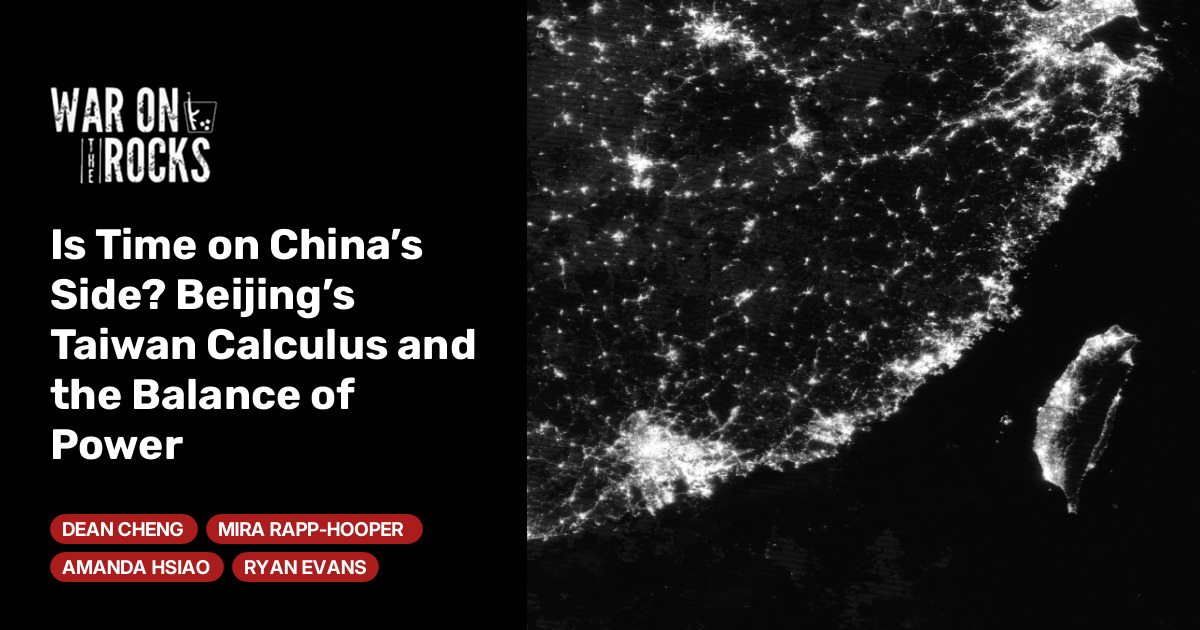
When is the risk of war the highest? And what should the United States be doing about it? One of the most important but underappreciated questions in international politics is how states think about the future balance of power. Countries that believe their position is improving often choose patience. Those who fear their position is deteriorating may feel pressure to act before their advantages disappear. In this episode, Ryan is joined by Dean Cheng, Mira Rapp-Hooper, and Amanda Hsiao to explore how Chinese leaders may be thinking about time, power, and Taiwan. This episode is sponsored by Ki
Discussions around China's Taiwan calculus are intensifying as global geopolitical tensions rise and China's military modernization progresses, prompting assessments of the 'window of opportunity' Beijing might perceive.
Understanding China's strategic timeline and its perception of the balance of power is crucial for assessing the risk of conflict in the Indo-Pacific and informing international deterrence and preparedness strategies.
This analysis provides deeper insight into the strategic rationale guiding potential Chinese actions regarding Taiwan, shifting focus from mere capability to intent and perceived opportunity.
- · Defence strategists
- · Geopolitical analysts
- · Status quo assumptions
- · Taiwan's economic stability
Increased focus on China's long-term military and economic projections.
Heightened urgency for regional powers to solidify defence pacts and capabilities.
Potential for an arms race or accelerated technological decoupling as perceived strategic timelines shorten.
This signal links to a primary source. Continuum Brief monitors and indexes it as part of the live intelligence stream — we do not republish source content.
Read at War on the Rocks