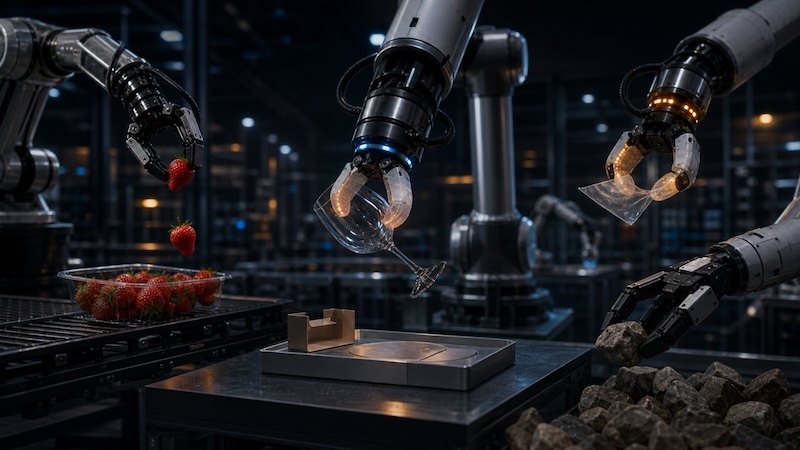
UK robotics startup Kirisense has secured funding from the Henry Royce Institute to develop advanced tactile sensing technology designed to give robots a more human-like sense of touch. The project, supported through the Henry Royce Institute’s Industrial Collaboration Programme and delivered in partnership with the University of Sheffield, will focus on creating robotic fingertips capable […]
The increasing demand for advanced automation in complex environments and the maturation of AI and sensor technologies are driving innovation in robotic tactile sensing.
Improved tactile sensing is a critical bottleneck for advanced robotics, enabling more dextrous manipulation and opening up new applications for automation.
Robots will become more capable of interacting with unstructured environments and delicate objects, reducing the need for highly controlled industrial settings.
- · Kirisense
- · Advanced manufacturing
- · Logistics and supply chain
- · Robotics startups
- · Manual labor in complex tasks
- · Current robotic end-effector manufacturers without advanced sensing
More sophisticated robotic systems will emerge for tasks requiring fine motor skills and adaptive manipulation.
Reduced operational costs and increased efficiency across various industries due to enhanced robotic dexterity.
The development of truly general-purpose humanoid robots could accelerate, impacting labor markets and societal structures more broadly.
This signal links to a primary source. Continuum Brief monitors and indexes it as part of the live intelligence stream — we do not republish source content.
Read at Robotics & Automation News