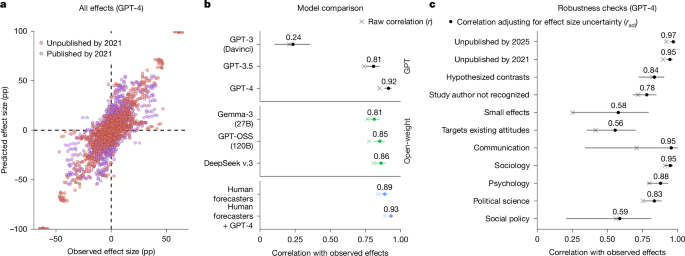
Nature, Published online: 08 July 2026; doi:10.1038/s41586-026-10742-x Large language models can be used to estimate the results of social science experiments about as accurately as a group of human forecasters—even for experiments published after the models were trained—although they tended to overestimate effect sizes.
The rapid advancement and increased sophistication of large language models, coupled with growing data accessibility, allow for their application in complex analytical tasks like predicting social science experiment results.
This development suggests LLMs can become critical tools for forecasting and understanding human behavior, impacting areas from policy-making to market research and strategic planning without needing extensive human expert groups.
Traditional methods of social science forecasting and analysis may be augmented or even partially replaced by LLM-driven predictions, offering faster and potentially more scalable insights.
- · AI developers
- · Social science researchers
- · Market research firms
- · Policymakers
- · Human forecasting groups
- · Traditional survey methodologies
LLMs provide rapid, scalable initial assessments for social scientific phenomena.
The cost and time associated with early-stage social science research and policy testing could be significantly reduced.
LLM biases, if not properly mitigated, could inadvertently shape or misrepresent societal understanding and policy outcomes on a large scale.
This signal links to a primary source. Continuum Brief monitors and indexes it as part of the live intelligence stream — we do not republish source content.
Read at Nature — Latest Research