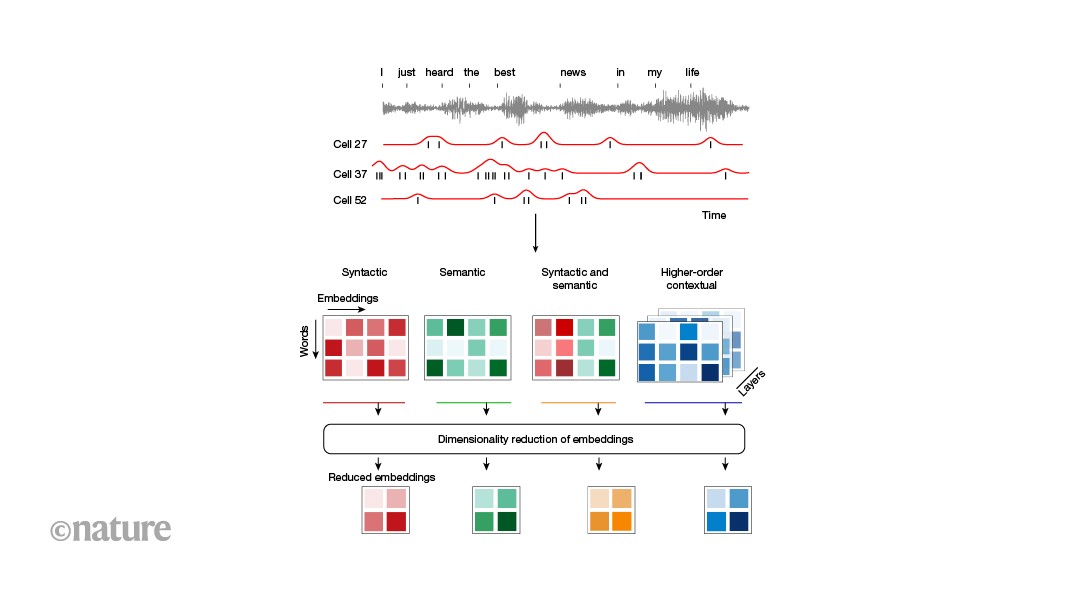
Nature, Published online: 01 July 2026; doi:10.1038/d41586-026-02004-7 By combining recordings from single neurons with artificial-intelligence techniques, specific brain cells have been identified that could enable humans to generate language. These cells, which are distributed broadly across the human brain, encode specific aspects of meaning and grammar and reflect how words are assembled into phrases and sentences.
Advances in AI techniques combined with increasingly sophisticated neuroscientific recording methods have converged, enabling a deeper understanding of neural language processes.
This research provides fundamental insights into the biological underpinnings of language, which could dramatically accelerate developments in AI speech generation, brain-computer interfaces, and neurological disorder treatments.
Our understanding of how the human brain encodes and assembles language is now more precise, moving beyond broad neural regions to specific cell types and their functions.
- · Neuroscience researchers
- · AI speech generation companies
- · Brain-computer interface developers
- · Pharmaceutical companies investigating neurological disorders
- · Companies reliant on primitive language understanding models
Refined AI models for understanding and generating human-like speech with greater accuracy and nuance.
Development of more sophisticated brain-computer interfaces that allow for intuitive direct thought-to-speech translation.
Ethical and philosophical debates surrounding the nature of consciousness and communication as machines approach human-level internal linguistic processing.
This signal links to a primary source. Continuum Brief monitors and indexes it as part of the live intelligence stream — we do not republish source content.
Read at Nature — Latest Research