Misreading Myanmar’s War: Why the Junta’s Recent Gains Don’t Mean Imminent Victory
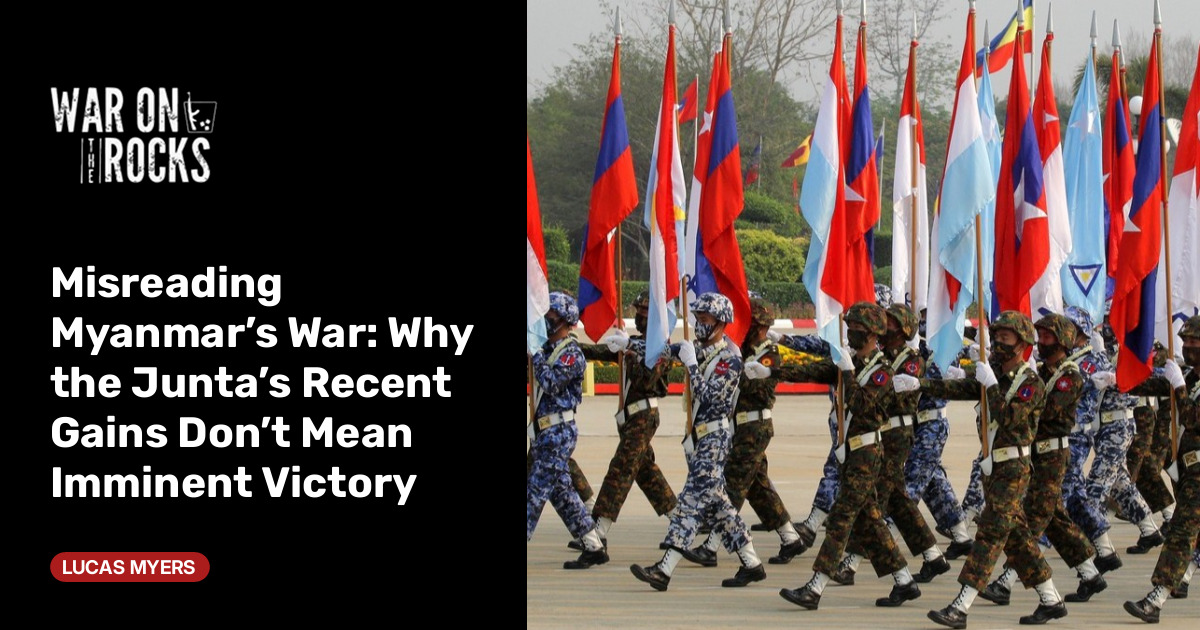
To understand how close Myanmar’s pro-democracy resistance came to victory last year — and how far it has slipped since — there is no sharper microcosm than the story of a Gen Z sniper. In April 2025, a female teenager, Anina, enraptured the world, her youth-driven “Spring Revolution” a vivid foil to the sclerotic forces of military dictator Min Aung Hlaing (officially called the Tatmadaw). When her unit captured the town of Falam, fortune seemed on the resistance’s side. Yet, a year later, regime troops stormed Anina’s hometown, a stunning blow to the resistance.Many observers had predicted t
The article highlights recent shifts in the Myanmar conflict, with the junta regaining ground after a period of resistance gains, indicating a critical juncture in the 'Spring Revolution'.
This conflict offers a real-world crucible for understanding modern counterinsurgency and the role of popular movements against established military forces, with implications for U.S.-Chinese regional influence.
The perceived momentum of the pro-democracy resistance has been challenged, forcing a re-evaluation of its immediate prospects and the stability of the military junta's control.
- · Myanmar Junta
- · Military Industrial Complex
- · Myanmar Pro-Democracy Resistance
- · Civilian Population (Myanmar)
The military junta consolidates control over key territories, weakening the resistance's popular support and logistical networks.
Increased humanitarian crisis and refugee flows as conflict persists and the junta exerts more brutal control.
Regional powers, including China and the U.S., may adjust their strategic engagement with Myanmar based on the perceived stability of the junta.
This signal links to a primary source. Continuum Brief monitors and indexes it as part of the live intelligence stream — we do not republish source content.
Read at War on the Rocks