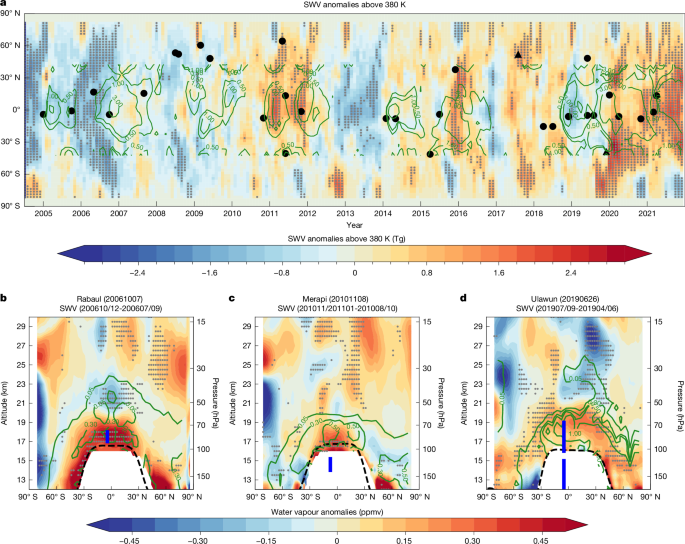
Nature, Published online: 01 July 2026; doi:10.1038/s41586-026-10731-0 Observations and modelling show that volcanic eruptions and extreme wildfires have systematically increased stratospheric water vapour since 2005, revealing that these episodic aerosol perturbations are a previously overlooked driver of stratospheric water vapour variability.
New research identifies a previously overlooked driver of stratospheric water vapour variability since 2005, highlighting an accelerating impact from volcanic eruptions and extreme wildfires.
Understanding the drivers of stratospheric water vapour is crucial for accurately modeling climate change, as it acts as a significant greenhouse gas and influences atmospheric chemistry.
Climate models will need to incorporate these episodic aerosol perturbations as a more significant factor, potentially altering projections for global warming and regional climate patterns.
- · Climate scientists
- · Atmospheric modeling companies
- · Renewable energy sectors
- · Fossil fuel industries
- · Regions vulnerable to extreme weather
- · Agriculture in affected zones
Increased stratospheric water vapour contributes to a stronger greenhouse effect, leading to higher global temperatures.
Altered stratospheric composition could impact ozone layer recovery and increase the frequency or intensity of extreme weather events.
More profound and rapid climate shifts could necessitate accelerated decarbonization efforts and significant global adaptation investments.
This signal links to a primary source. Continuum Brief monitors and indexes it as part of the live intelligence stream — we do not republish source content.
Read at Nature — Latest Research