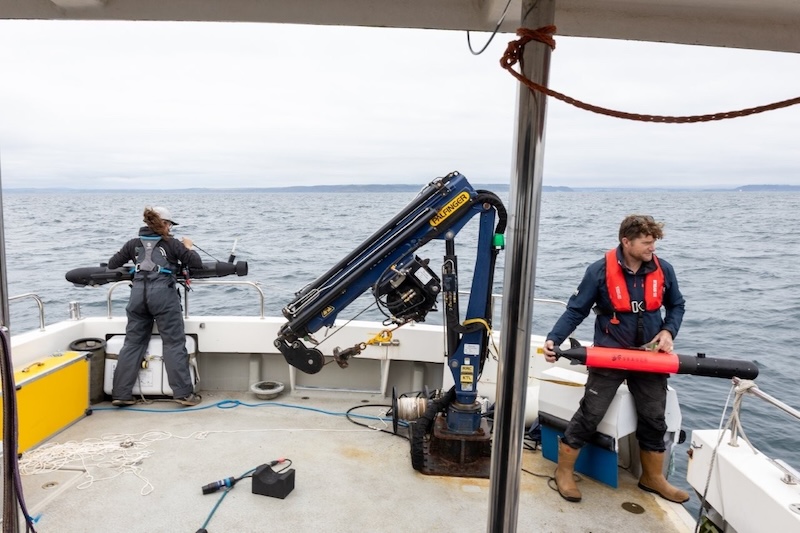
A new underwater trials site designed to accelerate UK marine autonomy and ocean sensing has completed its first major test thanks to a live, multi-marine surface and subsea robotic platform demonstration. The Smart Sound Connect Subsurface (SSCS) project, part of Smart Sound Plymouth, led by the University of Plymouth, with Plymouth Marine Laboratory (PML), saw […]
The UK is actively investing in marine autonomy capabilities to enhance its defense and economic interests, particularly in subsea environments, driven by geopolitical shifts and technological advancements.
This development signifies strategic national investment in autonomous subsea capabilities, essential for defense, resource management, and maritime sovereignty, reducing reliance on human-crewed assets.
The establishment of dedicated subsea test ranges and successful multi-robot demonstrations accelerate the development and deployment of autonomous underwater vehicles, moving from theoretical to practical application.
- · UK defense industry
- · Marine technology companies
- · Robotics and AI research institutions
- · Navies globally
- · Traditional crewed marine vessel manufacturers
- · Nations without significant marine autonomy R&D
The UK's marine autonomy sector will see accelerated innovation and commercialization of new subsea technologies.
Enhanced subsea surveillance and operational capabilities will emerge, impacting maritime security and resource exploration globally.
A potential arms race in autonomous underwater systems could develop, altering naval power dynamics and subsea geopolitical strategies.
This signal links to a primary source. Continuum Brief monitors and indexes it as part of the live intelligence stream — we do not republish source content.
Read at Robotics & Automation News