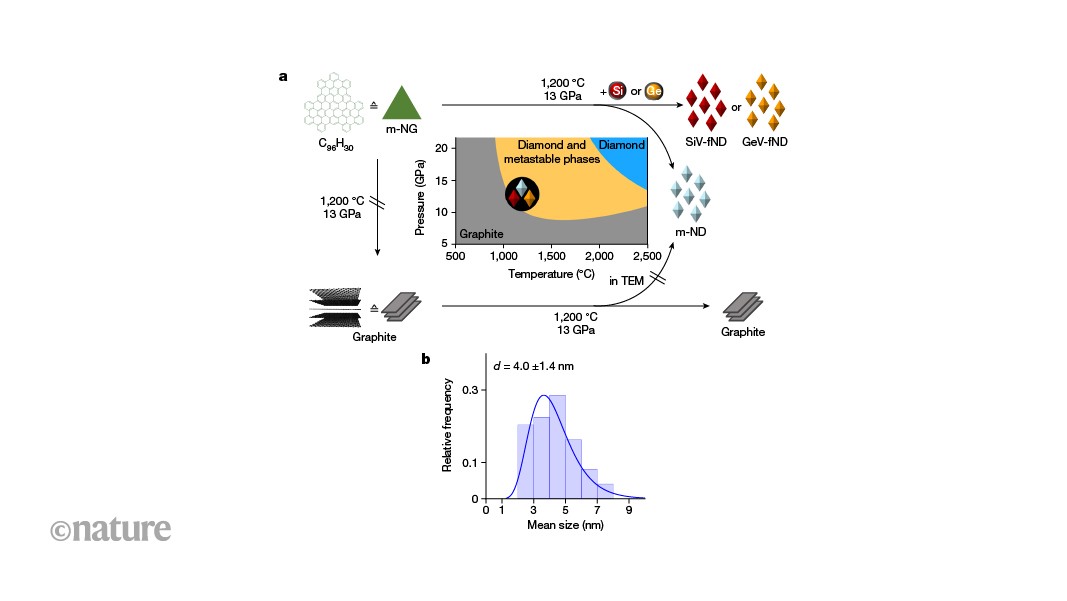
Nature, Published online: 01 July 2026; doi:10.1038/d41586-026-02001-w Nanodiamonds can host atom-sized light emitters for quantum sensing and imaging, but making nanodiamonds that are small, crystalline and uniform has been difficult. A single-step process for making nanodiamonds only 3–4 nanometres in size uses planar carbon ‘nanographene’ molecules with hydrogen atoms on the edges, and can be adapted to generate fluorescent nanodiamonds.
This research provides a single-step, scalable method for creating uniform nanodiamonds, a critical enabler for quantum technologies, addressing a long-standing manufacturing challenge.
Nanodiamonds are crucial for quantum sensing and imaging due to their atom-sized light emitters, and this breakthrough accelerates their practical application by simplifying production.
The ability to produce small, crystalline, and uniform nanodiamonds more easily opens new avenues for quantum technology development and potential industrial applications.
- · Quantum computing researchers
- · Materials science
- · Sensor manufacturers
- · Medical imaging
- · Current complex nanodiamond manufacturing techniques
- · Companies relying on less efficient quantum material synthesis
Mass production of high-quality nanodiamonds becomes more feasible, lowering entry barriers for quantum sensing applications.
Improved quantum sensors lead to advancements in medical diagnostics, precision navigation, and fundamental physics research.
Widespread adoption of quantum sensing could enable entirely new fields of technology and industries previously limited by sensor capabilities.
This signal links to a primary source. Continuum Brief monitors and indexes it as part of the live intelligence stream — we do not republish source content.
Read at Nature — Latest Research