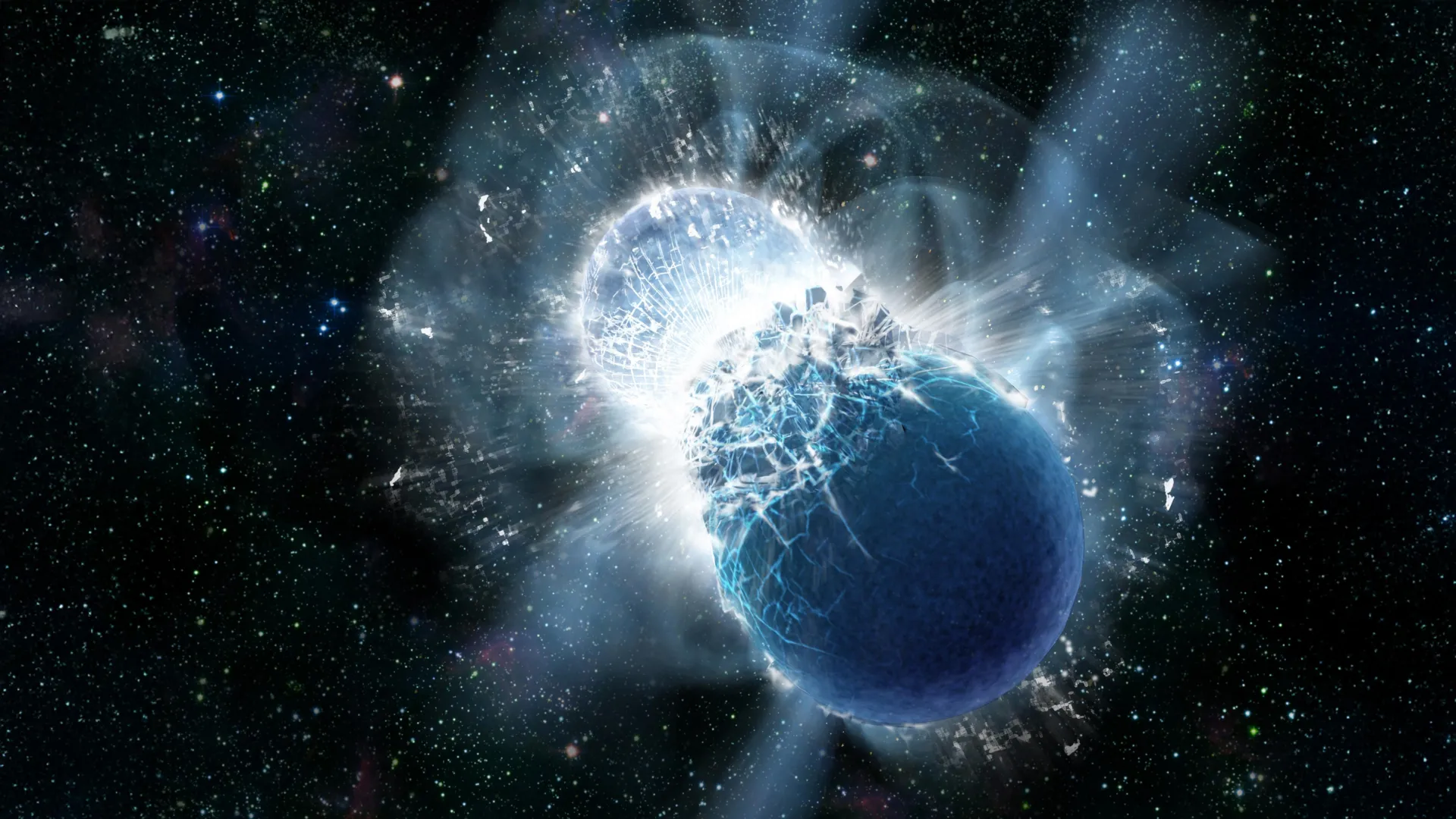
Researchers have created an AI-based simulation that makes it much faster to model how neutron star mergers produce many of the universe's heaviest elements. The new tool could improve predictions of these powerful explosions while helping scientists better connect observations in space with experiments on Earth.
Advances in AI modeling capabilities are enabling breakthroughs in complex scientific simulations, such as those related to astrophysical phenomena.
This development can significantly accelerate the understanding of fundamental processes that forge heavy elements, influencing fields from astrophysics to materials science and potentially nuclear technology.
The ability to rapidly model neutron star mergers using AI reduces computational time and could improve predictive accuracy for these cosmic events.
- · Astrophysicists
- · Computational Scientists
- · AI/ML Research Sector
- · Traditional high-performance computing methods for astrophysical simulations
Faster and more accurate simulations of nucleosynthesis from neutron star mergers become possible.
Improved understanding of the origins and distribution of heavy elements could refine theories of planetary formation and material properties.
Potential for new insights that could inform advanced materials engineering or even novel energy sources based on understanding extreme elemental creation.
This signal links to a primary source. Continuum Brief monitors and indexes it as part of the live intelligence stream — we do not republish source content.
Read at ScienceDaily — Quantum Computing