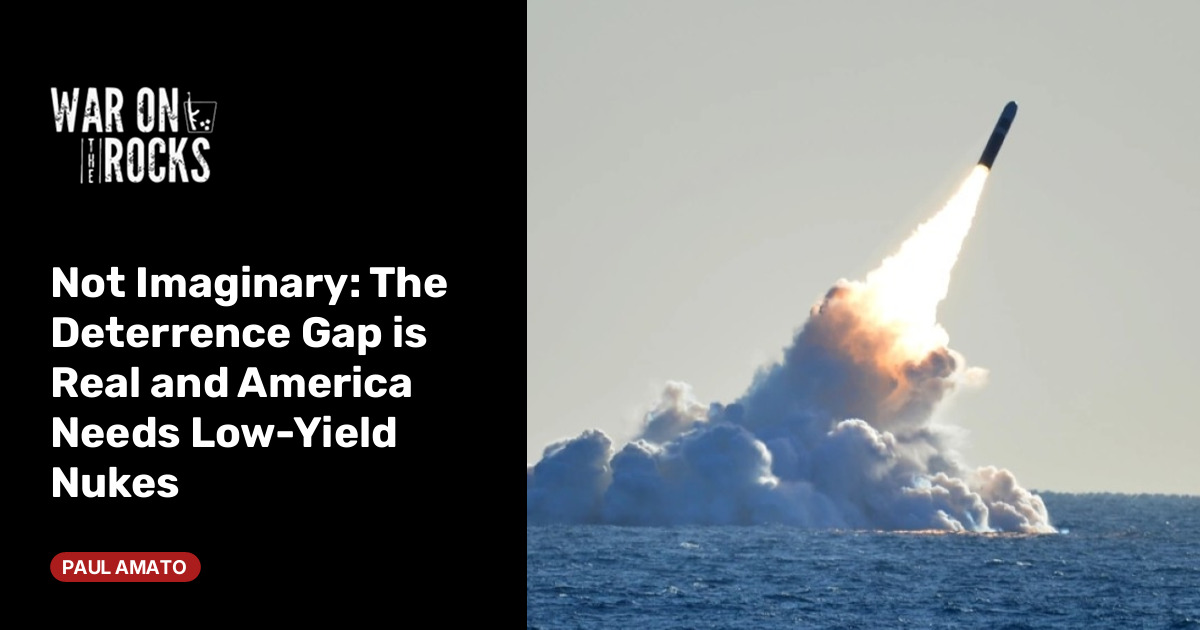
Nuclear policy debates are at their best when they force hard questions about risk, deterrence, and military necessity. They are at their worst when disagreement is recast as bad faith. In 2018, as an outgrowth of a rigorous policy review process, the Trump administration’s Nuclear Posture Review identified a need for supplemental low-yield nuclear capabilities to augment the U.S. nuclear arsenal. This was presented as an effort to raise the nuclear threshold of adversaries who may believe they could employ nuclear weapons in limited ways to escalate their way out of failed or failing conventi
The debate about low-yield nuclear weapons resurfaces as geopolitical tensions rise, with adversaries potentially perceiving a conventional advantage or a pathway to limited nuclear escalation.
This discussion implies a significant shift in deterrence strategy, moving towards a more 'usable' nuclear arsenal, which could lower the nuclear threshold and increase the risk of proliferation and conflict.
US nuclear policy is being re-evaluated to include low-yield capabilities, aiming to close a 'deterrence gap' and deter limited nuclear use by adversaries, potentially leading to a renewed nuclear arms race.
- · US Defense Industrial Base
- · Nuclear-armed states seeking similar capabilities
- · Nuclear strategy think tanks
- · Global arms control efforts
- · International stability
- · Non-nuclear states
The US develops and deploys new low-yield nuclear weapons, revising its nuclear posture.
Other nuclear powers, particularly Russia and China, respond by developing or expanding their own low-yield nuclear arsenals.
The proliferation of more 'usable' nuclear weapons increases the probability of limited nuclear exchanges in regional conflicts.
This signal links to a primary source. Continuum Brief monitors and indexes it as part of the live intelligence stream — we do not republish source content.
Read at War on the Rocks