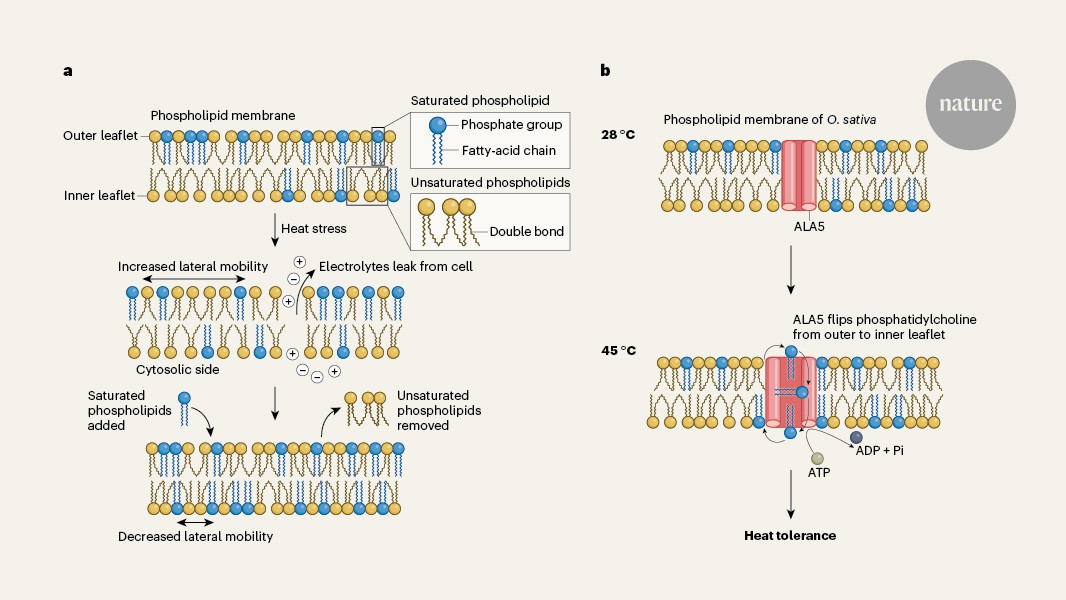
Nature, Published online: 01 July 2026; doi:10.1038/d41586-026-01809-w High temperatures make cell membranes weak and leaky. Rice plants rapidly counteract this effect by adjusting membrane lipid content, enabling them to resist heatwaves.
The publication in Nature highlights a novel mechanism by which plants adapt to heat, offering new avenues for research into climate resilience. This research emerges as global temperatures continue to rise, making heat stress a critical agricultural concern.
This breakthrough provides a foundational understanding that could lead to engineering crops more resistant to climate change, directly impacting food security and agricultural economics. It represents a significant advancement in synthetic biology and plant science.
Our understanding of plant adaptive mechanisms to heat stress is deepened, potentially enabling the development of advanced agricultural biotechnologies to safeguard global food supply.
- · Agricultural biotechnology companies
- · Farmers in heat-stressed regions
- · Plant scientists
- · Consumers of agricultural products
- · Regions heavily dependent on unreformed, heat-sensitive crops
- · Traditional agricultural methods
Genetically engineered crops with enhanced heat resistance become viable solutions for food security in a warming climate.
Reduced crop losses due to heatwaves lead to more stable food prices and potentially shift agricultural production zones.
Widespread adoption of heat-resistant crops could mitigate some of the economic and social impacts of climate change on food systems, but may also raise new questions about biodiversity and agricultural monopolies.
This signal links to a primary source. Continuum Brief monitors and indexes it as part of the live intelligence stream — we do not republish source content.
Read at Nature — Latest Research