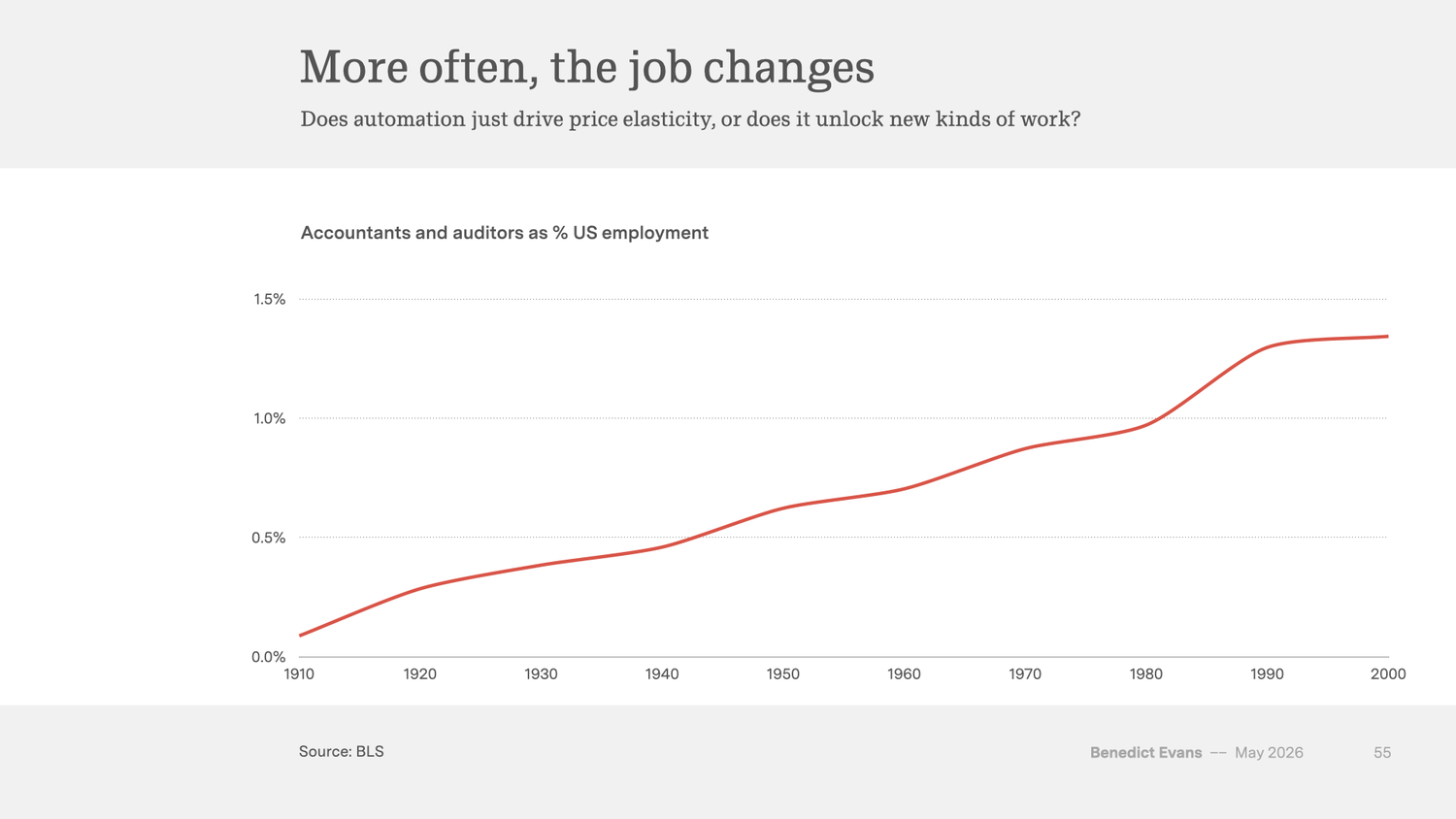
Many people would like to analyse which jobs, companies and industries are most exposed to AI, and assign scores, build charts, and map that against the progress of LLMs. I think this is mostly impossible: you don’t know how the jobs will change, you don’t know what else will change around this, and you can’t measure work like that anyway.
The rapid advancement of LLMs has intensified public and private sector efforts to quantify AI's specific impacts on employment.
A strategic reader should care because the inability to accurately predict AI's job exposure signifies a fundamental challenge in workforce planning, economic forecasting, and policy development.
The conventional wisdom that AI's impact on jobs can be precisely modeled is now being called into question by major analysts.
- · AI developers focused on adaptable, general intelligence
- · Consultancies specializing in organizational agility
- · Education providers for continuous reskilling
- · Economic forecasters using static job models
- · Companies with rigid workforce structures
- · Analysts attempting granular job exposure scoring
There will be a heightened awareness of the intrinsic unpredictability of AI's societal transformation.
Investment will shift towards AI applications that augment human capabilities rather than strictly automate existing roles, due to the difficulty in foreseeing specific job displacement.
The difficulty in predicting job impacts could accelerate the debate around universal basic income or other social safety nets, as traditional employment models become harder to manage and forecast.
This signal links to a primary source. Continuum Brief monitors and indexes it as part of the live intelligence stream — we do not republish source content.
Read at Benedict Evans